Thursday, October 6, 2022

Miraculous beyond measure: Themes and Thinking in S.F. Said's "Tyger"


Nothing is ordinary,” said the tyger. “Everything is extraordinary. In all of infinity and eternity, that flower exists only in this world; this precise position in space and time. Everywhere else, there is a different flower, or no flower at all. And the same is true of you. Nothing special? You are miraculous beyond measure, both of you.

S.F. Said, Tyger (2022)


On August 18th 2022, A-Level results day, the TES announced that English Literature had finally dropp


ed from the Top 10 most popular A-Level subject choices. Forecast for a while,
The Guardian had back in 2019 reported on 'a 13% decline [that] summer in entries for all types of English A-level' (WEALE, 2022). A NATE Position Paper opined: 

One of the pleasures of English studies has always been the experience of discovering insights that go beyond language and literature through detailed discussion and analysis of text. This is what Barbara Bleiman (2019) calls ‘big picture English’. A student’s first exposure to a text should be geared around the primacy of the reading experience (Cushing and Giovanelli 2019). Student experience of English study today, however, tends to be a microcosmic analysis of textual features and their alleged ‘effects’ rather than on reading for meaning with close textual reference. This tendency has developed over more than two decades since the introduction of the National Literacy Strategy in 1997. Its effect has been to reduce English studies to the transmission of supposedly correct, objective knowledge about language and literature. This is evident at every level, from the current primary language curriculum to the official view of literary texts as ‘cultural capital’, knowledge of which is good in itself, rather than as a means of pleasurable reflection on and participation in life.

NATE, The Decline in Student Choice of A Level English (2019)


Later, came the final nail in the coffin:

When children write about their reading, there is now an overwhelming emphasis from Year 7 onwards on writing paragraphs of micro-analysis of literary texts using formulae such as the ubiquitous PEEL (Gibbons 2019). It is little wonder that many 15-year-old students report they no longer read for enjoyment (Lough 2019). An English graduate known to one of the writers reported that her 14 year old daughter asked her: ‘Why would you want to study English at university? It’s so boring!’

ibid.

So the 2022 drop of English Literature from the Top 10 subjects is hardly surprising; almost to be expected in fact. And, yes, a bleak picture, certainly. 

In other news, just a few days before the A Level announcement, S.F. Said tweeted a picture of the final hardcover first edition of his Tyger, saying: 

This means everything to me. I've put everything I have, everything I know, everything I love into Tyger. So it's an emotional moment, holding the finished book in my hands.

S.F. Said, Tweet, 12th August

Tyger follows three earlier, very popular novels by Said so its publication has already been much-anticipated. In addition to this, it has taken nine years to write and early reviews of the novel mention 'future classic' status. But I must admit that I was surprised when I received an early proof that it was but a fairly modest size. I had been expecting something more like Phoenix, Said's third novel, something more...big. But when I finally came to read the novel, I found my first impressions were wrong - SO wrong. I tweeted on 21st June: 

I am taking [Tyger] VERY slowly. There are moments when I have to stop reading because the writing is so breathtaking, I can’t read on. Some passages are like nothing else I’ve read and so intensely vivid I have to remind myself that I’m not *there*. It bursts at the seams with ideas yet the story pace is perfect. There are so many layers here, symbol on symbol like a great palimpsest of history and philosophical thought. But the story is timely and the Vision…infinite.

I couldn't write about Tyger for months. I didn't know what to feel or think, only knowing that I had read something vital. Where had it left me? I didn't know then, and am still not sure that I know now. What makes it such a big book for us all to read, especially children and their teachers, and why exactly we should read it? It was on that Results day that I started to see that the bleakness of those stories of our Education system and the brilliance of Said's tygers might just prove to be two sides of the same coin.

That coin I’ll return to again later; in the meantime I’d like to offer some ‘Big Picture’ thinking for a Big Book. I’ll start by welcoming in Mister William Blake.

***

Artist, poet, printmaker, free-love advocate, Romantic, William Blake (1757-1827) is hardly disguised as the major influence of Tyger. The title alone, the spelling, immediately invokes the well-known tattoo:

Tyger Tyger

(...those two trochees that beat their way into our consciousness the very first time we hear them...)

burning bright,

(...sparking fires in the imagination...)

In the forests of the night;

(...whilst all around remains dark, knotted, tangled.)

Tyger goes far deeper into Blakean symbols, mythologies and themes than just the eponymous character; so much deeper in fact that anything less than ‘Big Picture’ reading leaves us lost and overwhelmed by those ‘forests of the night’. If we allow ourselves with Tyger to ignore that kind of reading, then things far too quickly turn 'boring'.

I wander thro' each charter'd street,

Near where the charter'd Thames does flow. 

And mark in every face I meet

Marks of weakness, marks of woe.


In every cry of every Man,

In every Infants cry of fear,

In every voice: in every ban,

The mind-forg'd manacles I hear 

[...]

William Blake, London (verses 1 and 2)


One peculiarity of Tyger appears at the very beginning of the book: 

It happened in the twenty-first century, 

when London was still the capital of an Empire, 

and the Empire still ruled the world…

This is not the London we know, quite. It is a London of the present and future, yet in so much of the novel the feel, the atmosphere of the story is older, more suited to the world of the late eighteenth century, the time of the Enlightenment, the Georgian world of William Blake. The social order of things has men arriving on horseback to proclaim in city squares; technology is seemingly non-existent - phones, tablets, email, computers are noticeably absent; Tesco and Sainsbury’s have given way to what seem like small, independent businesses - shoppes, perhaps; a thick (maybe more Victorian!) pea-souper lours over the city. 

Regardless of its old-fashioned feel, the impression of the capital is hardly an inspiring one: dirty streets, abandoned warehouses, sites fenced off for reconstruction. The streets, like Blake’s, are 'chartered', owned by and under control of the status quo and the barrier described at the very start of the novel forms perhaps a physical symbol of these borders. 

Why? Why this ‘future of the past’?

This is not a country of progress; in fact Albion has regressed some two hundred years! Albion has fallen, yet still waves its tattered standard, stubbornly refusing to admit the truth of its fate. A foul, pig-headed ignorance has taken hold. Citizens chant ‘Foreigners out!’. This is a post-Brexit novel, riddled with the fear of losing power to foreign ‘others’ and the attendant ironic portrayal of those who have created a social order that rewards no-one but the rich. 

Writing in The Guardian in 2014 (the time of which would also tie in with the early days of Tyger’s composition), Said said: 

I came to Britain in 1970, when I was two. I don’t remember living anywhere else. I don’t look obviously Arab, so I seldom faced racism on the street, but whenever my name came up, everything changed. What kind of name is that? Where are you from? And why don’t you go back there?


Back then, there weren’t many Arabs or Muslims where I lived. I felt very different to everyone around me. In Britain, I was seen as a foreigner, while in the Middle East, I was seen as British. I felt like I belonged nowhere.


The only place I felt at home was in books.

S.F. Said, “Books showed me it was alright to be different”, The Guardian, 15th October 2014

When Adam finds himself at one of those checkpoint-barriers leading out of the streets more familiar to him onto the more salubrious Oxford Street, he is questioned, rather as Said was, regarding his name and origins. Adam is finally allowed through, though it’s implied that the guard would rather Adam knew his place, figuratively and literally, and stay exactly where he belongs - like those other ‘good’ citizens who play by the rules, their minds manacled so easily. 

Adam, though, is different to them; even at this very early point of the novel, he demonstrates his independence from the drudge of work. He is on an errand, a servant, yes, but one brave enough to complete his mission, one who goes so far as to cross boundaries to do so. It is a quiet but momentous indication of Adam's destiny.

Division, separation, is apparent elsewhere too in the references to the River Walbrook, one of London’s ancient subterranean waterways. Some think that its name comes from the Saxon weala broc ('river of foreigners’), where it split the city of Londinium into the eastern side on Cornhill and the western Ludgate. This latter portion of land had a cathedral, royal residences and was generally ‘higher status’.  By its inclusion, the Walbrook metaphorically and physically invokes echoes of racist fears from history, showing us that what we read about in Tyger is nothing new: groups of people have been looked down upon - literally, even, from horseback or hill! - for centuries. 

Soon, Adam finds Tyger and, in her, Blake’s greatest theme is made incarnate. The poet set it down in just one line:

The tygers of wrath are wiser than the horses of instruction.

William Blake, The Marriage of Heaven and Hell 

…meaning that the wildness of the 'untameable' creative  is ‘greater’ than the trained, rule-follower. 

Before we consider those wrathful tygers, let’s turn first to the horses. In Blake’s Visions, even the hard work and effort of horses is not as highly regarded as the mystical nature of inspiration. In Tyger, horses appear (literally) beneath their masters, controlled, obedient, subservient: 

Some lords rode down the first class lane on horseback. Their slaves followed behind them. (p. 66)

Then, comes a horrifying tableau: 

Four horsemen in scarlet coats, with white faces; with long leather whips and rifles in their hands. Each one was flanked by a pair of hounds. 

A kind of eighteenth-century, powdered (white) aristocracy in bloody livery, a macabre parody of the traditional hunt. No pistols though, these are rifles, guns with power. A rank stink begins to creep into the narrative. 

One of the huntsmen declares to the assembled crowd: 

“The beast has escaped from my lord’s menagerie [...] You may believe such beasts exist but this one is alive and dangerous. If you see it, or hear anything about it, report it at once [...]”

S.F. Said, Tyger (pp. 67-68)

The hunt is on: Find the tyger! Do not listen to its lies! It must be destroyed! Here are echoes of the mechanical cats in Varjak Paw - they smelled wrong, just like these men on horseback. Both sets of characters are there to keep a stranglehold order. There is no place in their London for tygers. What tygers mean is too difficult for them to contemplate…and even more difficult for them to control. 

This Tyger, prophet-like and most certainly, dangerously, alive - no figment of London gossip! - is paving the way for a boy and a girl towards something far, far beyond those lords’ cold, stone hearts. (Also, it must be noted that once the order begins to fall apart later in the book, happily those horses do get to run ‘wild’).

***

If the doors of perception were cleansed every thing would appear to man as it is, Infinite. For man has closed himself up, till he sees all things thro' narrow chinks of his cavern.

William Blake, The Marriage of Heaven and Hell 

Throughout the novel, the two main protagonists, Adam and Zadie, encounter Doors. The first of these are the Doors of Perception, Blake’s metaphor for the limits of and passages ‘through’ consciousness. Blake’s ‘cavern’ for Adam is transformed into ‘a ruined building in a dump’, and the ‘narrow chink’ becomes 

‘A crack down the middle, between the doors, through which he could see a whisker of light. The brightest light he had ever seen.’ (p. 57) 

Is Blake’s Vision becoming too complex an image for a book with a young audience in mind? Not at all. It is both testament to Said’s belief in the Infinite possibilities of the child’s imagination and joyous, encouraging celebration thereof, and alarm-call to the grown-ups who run the world and shape the childhoods of young people: Who is it who closes those doors? Who is it who shuts down the perceptions of young people? 

I heard Katya Balen speak at an Open University Reading for Pleasure conference recently. Talking about reading in her keynote speech (paraphrasing here): 

Children should read widely and what they want to read, not be cut off at the root. Children make their choices and if those choices are not noticed - or scorned - then that part of their development is crushed. It’s something I feel strongly about.

Katya Balen, Keynote at OURfP Conference 1st October 2022

She kept returning in her speech to the teacher in Year 3 who gave her an exercise book with the instruction to write in it what she wanted, not bound by grammar rules or restricted, tightly (teacher-)planned subjects. This is what Balen needed, she said, as a child: she needed freedom. Freedom to explore. Freedom to pass through those Doors, not in want or need of any particular key that teachers thought was the right one. Freedom, so that untethered, her imagination could burn bright. 

Then, talking of her own writing, came the thunderbolt:  

I want to focus on those small details of what is around us…and expose the world.

A writer for children, like Said, echoing the great words of Blake from two centuries earlier: 

To see a World in a Grain of Sand

And a Heaven in a Wild Flower,

Hold Infinity in the palm of your hand 

And Eternity in an hour.

William Blake, Auguries of Innocence (1808?)

When Adam passes through the first door, he finds himself in a Wildflower meadow: compared to the dirty squallour of his London, he has truly found himself in Heaven. Everything is wild, sprawling, open…free. This scene in particular from Tyger (as Blake’s Auguries poem does in part) encourages us to consider the depth, size and potency of even the smallest things: a fragile wildflower has infinity housed within it, thousands of billions of future wildflowers locked away in potentia in every seed it produces. The magnitude of enumerating every grain of sand on a beach, in the sea, and then to consider the trillion future grains locked away in huge rockfaces. Where did they come from? Where are they ‘going’? As Tyger says to Adam when he first passes through the Doors: 

Do not look ahead, or behind. Focus on what is here, and now. 

Tyger, p. 58


Perhaps thinking about it for too long, thinking about the sheer hugeness of what we are contemplating, will burn. As Adam contemplates his heart, it is at this moment too much for him and he passes back to the real world, back to the Night. Tyger tells him he is not yet ready to pass to the next set of Doors, that Adam has glimpsed in the distance. From another angle, Balen talks of this: 


I’m not really much of a nature person, but because of that I look more closely and appreciate it more. If you know something well you run the risk of not really seeing it properly. 


This is what thinking does! It’s dangerous if rushed and needs time. There is no hurrying thought! It opens the doors, lets in the light:  


Every Night & every Morn

Some to Misery are Born 

Every Morn and every Night

Some are Born to sweet delight 

Some are Born to sweet delight 

Some are Born to Endless Night 

We are led to Believe a Lie

When we see not Thro the Eye

Which was Born in a Night to perish in a Night 

When the Soul Slept in Beams of Light 

God Appears & God is Light

To those poor Souls who dwell in Night 

But does a Human Form Display

To those who Dwell in Realms of day

William Blake, Auguries of Innocence (conclusion)


Blake, like Tyger, shows us that there is no real perception (the ‘Lie’) if we do not See with heightened Perception.


Auguries and the world of Tyger are echoed too by C.S. Lewis: 


I was standing today in the dark toolshed. The sun was shining outside and through the crack at the top of the door there came a sunbeam. From where I stood that beam of light, with the specks of dust floating in it, was the most striking thing in the place. Everything else was almost pitch-black. I was seeing the beam, not seeing things by it. Then I moved, so that the beam fell on my eyes. Instantly the whole previous picture vanished. I saw no toolshed, and (above all) no beam. Instead I saw, framed in the irregular cranny at the top of the door, green leaves moving on the branches of a tree outside and beyond that, 90 odd million miles away, the sun. Looking along the beam, and looking at the beam are very different experiences.

CS Lewis - Meditation in a Tool Shed


This is another wondrous dimension to consider: what happens when you look through the Beam, look into and along the light? There is no toolshed (Said’s abandoned dump), no Beam even. Only the green of the trees, the Sun, that slim glimpse of Heaven! Being inside the Beam gives us a wider, intrinsically felt Experience: we move beyond un-knowing. We leave Innocence behind. 


Before we do that though, let's take a closer look at that concept of Innocence through another of Blake’s best-known poems, The Lamb. This poem is placed in dir
ect contrast to
The Tyger in the collection Songs of Innocence and Experience, Lamb and Tyger respectively. The connection between the two is mentioned explicitly in The Tyger: ‘Did he who made the Lamb make Thee?’, while placement of the poems in different ‘song-books’ - Innocence and Experience - may on first glance seem to set the two creatures as polar opposites: if The Lamb is ‘goodness’ then the Tyger is ‘badness’, surely? Is this actually the case, though?  


The interesting thing about the poem The Lamb is that, despite its sweetness and light, and strongly Christian rhetoric, the poem feels unstable - the Lamb may be Innocence incarnate but the questions that are voiced in the poem set a tone of shaky doubt. The strangest thing about the poem is that there are no question marks printed in Blake’s original. The Tyger too is full of questions, again about the animal’s creation, but here question marks punctuate the lines and stick out sharply. What does this grammatical oddity tell us about these creatures? 


If one considers that the two poems are about creation - ‘Who made the Lamb?’ ‘Who could ever have shaped the Tyger?’ - then the use of questions around this subject invoke a sense of Blake’s concepts of creativity. The urgency of ‘The Tyger’ is enhanced by breathless, ‘burning’ questions; the Lamb’s calm purity not so strongly questioned, much more gentle and laidback. As one interpretation, we therefore have a deeper kind of contrast posed by these two poems: on one hand, the ‘established’ Creation that we all know, safe and secure; on the other, there is the dangerous kind that burns and is wild. Both spark a kind of wonder. 


And yet…


I’ve been teaching now for over twenty years and I remember, clear as day, those early days of training, when I came across that Isis speech Philip Pullman gave on teachers and teaching. It sent far-reaching shockwaves through me - I see that now, though at the time it felt a more thrilling experience than the profound one it turned out to be. In the speech, he quotes an earlier teacher-writer, Marie L. Shedlock


[...]why are we in such a hurry to find out what effects have been produced by our stories? Does it matter whether we know today or tomorrow how much a child has understood?

quoted in Pullman (2003)


(How her words echo those of Bleiman!)


Pullman then turns the focus more sharply on the 'system' and attitudes of teachers at that time: 


The culture of exam after exam, test after test, with a curriculum like the deadly upas-tree that casts a blight over every corner of a child’s school life, cannot possibly encourage the kind of openness of mind, the intellectual curiosity which the best teachers have to have. 


I fear it will bring up a generation who are kind, who love children, who are full of good intentions; but who have been discouraged from intellectual adventurousness. Who are not interested in how things came about.


If the specifically Blakean allusions to Tygers and the Lambs are not made quite explicit yet then the ensuing passage really spells it out: 


Marilyn Mottram of the University of Central England in Birmingham, who has been studying the way the National Curriculum and the Literacy Strategy work in schools, wrote to me last month: “When I work with teachers on developing ways of using texts I’m frequently asked ‘… but are we allowed to do that?’ This sort of continuing anxiety about literacy teaching,” she goes on, “suggests that a culture of conformity has been quite securely established among our primary teachers and, like many others, I find this deeply disturbing.” 

Said’s Urizen is like this: his culture is likewise disturbing. This supernatural creature appears in Blake’s longer poems but unlike other references to the poet’s mythology, Said has chosen quite literally to transplant the character whole, with no disguise, echo or inference, into Tyger. His name is unchanged, and its meaning too: ‘Your Reason’...? ‘Horizon’: the distant view but ultimately the limit of what we can see? Wings may make Urizen seem angelic; though the vision is certainly not a heavenly one, more akin to the fallen angels led by Lucifer in Christian texts. His whip emphasises the oppression: the ultimate slave-master. 

Blake’s Urizen is drawn as an old man with a long beard, a weary face…even he is tired by his own net. In Blake’s drawings, his is no vital image, nor on face-value a dangerous one; though he certainly poses a dreary future for those ensnared by his traps.

Pullman too references these traps in his speech:

These young people [teachers] are tigers born in cages, and kept caged until they think that being caged is a natural condition; and they look down at themselves, and they see their magnificent stripes, and the only way they can understand them is to think that they themselves must be made of bars: they are their own cage; they dare not move outside the little space they occupy. But they are tigers still, if only they knew.

It is Reason that helps make those cages. Like that lingering, sticky guilt and even stickier ‘culture of conformity’ that Mottram describes, Urizen plots and fights, then fights some more:  The net Urizen has made of the Established, the Time-Worn, the attitudes of What’s-Been-Done-Before-Must-Be-Right does not tear, or even fray, easily. His whips of Self-Doubt sting like fire and keep their targets in their cages. 

So, for me, those ‘twin’ symbols of Tyger and Lamb are there, explicitly in the narrative of Tyger but very much haunted by the ghosts of Pullman and Blake:


Tyger appears first in a warehouse, right in the centre of the city, its brilliance setting the gloom and dirt of its surroundings in stark relief. She is badly wounded. Here is another of the book’s strongly marked visual images, one that makes the reader see the detritus of the city absolutely clearly, love Tyger instantly despite the peril, and yearn for her.


Lamb appears on the outskirts of London, in the hamlet fields of Highgate (much transformed from the district it is today!). It has managed to ‘escape’ the squallor we have identified in Tyger’s first scene, and now lives peacefully in the countryside. It gambols among the lush green grass! It breathes the fresh air! But it is ‘caged’, it has no freedom, and two shepherds to care for (manage?) it. Humans, kind though they may be, have twisted its existence to their desired intent. It wasn't difficult - Lambs tend not to be Tygers! "They offer themselves up like..." (ahem!) The scene plays itself out peaceably, though the reader really should consider what little Lamb’s ultimate fate is destined to be.


Meanwhile, Tyger runs wild. 


Said’s intent for these two symbols pulls together Blakean philosophy and Pullman’s politics into one original, exciting cord that runs, sparking and vital, through the whole novel.


***


The thing about Tyger - very likely the reason why I couldn’t speak about its impact on me for so long, and still can’t do so properly (as my ramblings here probably attest!) - is that it is so Big. In this essay, I’ve tried to shape a few references from the novel and a bit of knowledge about Blake into some coherent form, to help new readers and Teachers to see something of what I have seen in Tyger, and what I see in the spirit of Education. But it’s been hard and I’ve probably failed: Tyger won’t allow herself to be ‘framed’ that easily - maybe I ‘dared aspire’ too ambitiously! Tyger is full of stuff, so full it will take far longer than a few months for me to unearth and digest and make meaning of it all. In the meantime, I’m happy not to hurry myself and take my time and re-read and re-think. 


But although I haven’t any desire to answer everything I want to know about Tyger, I have always had those questions I mentioned earlier beating away deep inside: Why, today, do we need William Blake? Why indeed do we need Tyger? So I’d like, finally, to hazard a guess:


Firstly, Blake/Tyger speaks authentically to every child - regardless of background - of the powers of their imaginations. I don’t mean that because it has fantastical beasts and supernatural elements then it will appeal to those imaginations (though it will do that too!); I mean that Tyger will show them what their imaginations are, the challenges they might face in harnessing those possibilities- or at least in attempting to! It will show them to go beyond, to question what is ‘real’ and ‘true’ and ‘understood’. Tyger will show them that although their individual Perceptions may be different - wildly so, perhaps! - each one of them has potential and Greatness. Tyger encourages the realization of what is there, hidden maybe for now, but still there for the taking…if only those young readers are to be brave and be allowed to do so. 

Secondly, it speaks authentically to every teacher - and I don’t mean just those in classrooms; I mean every grown-up who Teaches young people, everyone who shows them the world, everyone who nurtures them to get better at stuff, everyone who helps them see  how their imaginations might fly. Tyger will show us all the magnitude of our responsibility and demonstrate the sensitivity with which we must wield it. Like Said’s great cat, let all our teaching be as muscular, strong, wise, powerful, fierce, lithe, elegant...Humble. 

Earlier in this blog, I said that those grim stories of the Education system, specifically in the context of reading, were the counter-side of Said’s Tyger. I need to return to that coin now. 


That blasted coin. It’s the coin we grown-ups hold jointly, we grown-ups who find themselves in the powerful and highly responsible position of Teacher.

So, let’s toss it into the air…

…and while it spins…

                …then free-falls…

                                  … before it lands…

                                                    …let’s just pause a moment…

                                                                                          …and think: 

We can choose.

Defying all laws of (meta!)physical probability, we actually can choose which side up that coin will land. By some miracle, that coin could land Tyger-side every single time. 

Every. Single. Time. 

Imagine that! 

And if we make it happen, for every single child…? 

“Miraculous beyond measure”.


References

LEWIS, C.S. Meditation in a Toolshed http://ktf.cuni.cz/~linhb7ak/Meditation-in-a-Toolshed.pdf

PULLMAN, Philip.: The Isis Lecture (Lecture given at the Oxford Literary festival, 2003 ) https://www.philip-pullman.com/cm-content/pdf/isis_lecture.pdf 

SAID, S.F.: Books showed me it was alright to be different (The Guardian, 15th October 2014) https://www.theguardian.com/childrens-books-site/2014/oct/15/sf-said-diversity-in-childrens-books-1970s-uk 

WEALE, S.: 'Less fun' English declines as choice for A-level pupils (The Guardian, 14th August 2019 https://www.theguardian.com/education/2019/aug/14/less-fun-english-declines-as-choice-for-a-level-pupils )
A levels 2022: English lit drops out of top 10 most popular subjects (TES, 18th August 2022) https://www.tes.com/magazine/news/secondary/a-levels-2022-english-literature-drop-in-entries-subjects 

The Decline in Student Choice of A Level English (NATE, 2019) https://www.nate.org.uk/wp-content/uploads/2020/06/NATE-Post-16-position-paper.pdf 


With heartfelt thanks to Meggie and Fraser at David Fickling Books for providing the wonderful illustrations by Dave McKean and for sending me the novel itself in advance, to S.F. Said for his constant encouragement, and to Katya Balen for a last-minute inspiration! Tyger is published today, 6th October 2022. Please do support your local independent bookshop where you can.

Friday, September 16, 2022

Taking Time

It's the Journey Not the Destination by Carl Honore; illustrated by Kevin and Kristen Howdesell (Magic Cat 2022)

Slow Down and Be Here Now by Laura Brand; illustrated by Freya Hartas (Magic Cat 2022)

Life goes fast these days. As technology develops at a lightning-speed pace and the relentless busy-ness of the day threatens to overwhelm, many of the joys of taking the time to appreciate the moment and breathe can be easily overlooked. For out youngest readers, this is something that more than ever needs to be noted: their childhood - a precious, wide-eyed wonder - could slip by without a moment's notice, and how sad it would be to miss that. 

I have sung the praises of Magic Cat elsewhere on this blog and on Twitter; I've even used their website to inspire my class in their own publishing house ethos and manifesto! The books they are producing have a very timely relevance and both It's the Journey Not the Destination and Slow Down and Be Here Now are no exceptions. 

Mindfulness is something of which many children nowadays are aware. There are shelves of related colouring books available in shops, guides to techniques and music tracks for them to listen to. But what I love about these two Magic Cat books is that they tap into something very deep - almost primal - that many of us adults even are likely to forget: the taking of time to experience our world fully. 

Armchair travellers will delight in It's the Journey Not the Destination, as they take the time to laze slowly by on the river Cam, or cycle along the Silk Road to appreciate the historical significance of this time-worn trail. The prose is hypnotic and poetic, and casts a magical spell all of its own. The 'journeys' cascade one into the other, so we can be transported from the mysteries of Stonehenge to the equally extraordinary Macchu Pichu in the whisper of a turned page. 

A children book such as this that covers 'slow journeys' the whole world over, whether on foot or by train or by bike, is always going to be an inspiration to those young, imaginative readers: a whole lifetime of exploration could be mapped out just from reading this book. And I mean exploration not only of the very real kind of physical landscapes presented here, but also (and perhaps even more key for young readers) of the imaginative world that reading gifts us all. 

In Slow Down and Be Here Now, we are invited to watch - no, observe - Nature go about its daily routines, just as our ancient ancestors would have done. Indeed, the symbiotic relationships between Human life and the world around them are something that has always played a vital part to our survival. Whether you choose or not nowadays to 'Examine an Earthstar Mushroom as it blooms' or 'Watch a Frog catch a fly', these tiny-but-massive rhythms of life happen every day, the cycles of life continuous and reviving. How much more appreciative of the world would the next generation be, and how much more caring, if they were to notice! This book, using highly accessible but also expertly scientific language with gloriously warm illustrations to boot, helps them to do just that. 

Far, far more than being yet another book on animals or geography, both books are superbly designed to be shared and discussed and really are a truly wonderful gift to any young person. Their uniqueness really does excite me about further books from Magic Cat. Ideal for sharing between parent/teacher and child, the prose reads aloud beautifully in both books and the short double page spreads, allowing one journey or one natural phenomenon, are perfect for a little reading and a lot of talk and connection. They both look completely individual and enticing, with a highly attractive quality of illustration. In short, these are very special reads indeed. 

It's the Journey Not the Destination is available now from all good bookshops. Slow Down and Be Here Now can be preordered now; it will be published on 29th September 2022. 


Saturday, September 3, 2022

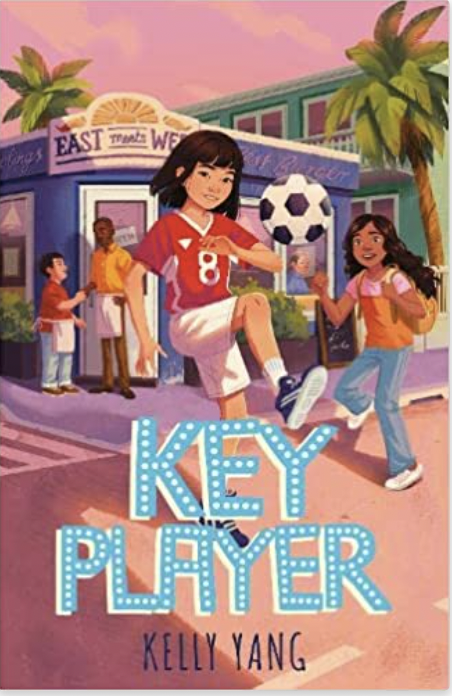
Key Truths

Key Player by Kelly Yang (Knights Of, 2022)


I love Kelly Yang's writing. 

When I began reading the Front Desk series a few years ago, I found myself carried away on a raft of fresh, enjoyably readable prose that compelled me always to read 'just one more chapter'. Then I read Parachutes, her first Young Adult novel, and the story it told truly shocked me. Along with this, the writing was so fluid and so confident  and I simply raced through the novel. 

My friends love Kelly Yang's writing. 

Sam Creighton described Front Desk as 'truly magnificent' and, following his being completely blown away after reading the novel, wrote an epic review for Just Imagine (https://justimagine.co.uk/review/front-desk/) . Sam is a highly selective reader. His thinking about books cuts to the absolute chase. For Front Desk to elicit this kind of response from him demonstrates the effect this book has in potentia for anyone lucky enough to read it.

And my classes love Kelly Yang's writing. 

Just after I myself read Front Desk, I lent my copy to a couple of particularly interested pupils: the book is a little bit bashed and its dustjacket scuffed but I love that its scars are multi-testament to the same affection I have for the book. When I read them Not from Here last year, there was real connection with the experiences described of COVID and empathy was developed hearing about Knox's experiences of racism and bullying. There was a lot of discussion, too, which is always a very good sign. 

For Yang's books to impress so many people shows how vital her writing is; and that they love her books proves that that the all-important emotional vitality is there, too. But as I began Key Player and the same delicious feeling of being in the welcome company of Mia, Hank, Jason - even Mr Yao! - wrapped round me again, I started to wonder (for the first time, funnily enough) just why her writing connects so much, and with so many. 

On page 121, I found my answer. There, tucked away quite unassumingly, was a Truth:

"[...]everyone was someone's child, even Mr Yao."

Mia, in that wonderful way of seeing that children can have, shows us that even the most apparently unpleasant people have come from somewhere, that they were children once too, they were vulnerable and scared and in need of care. 

As quickly as it appeared, though, this Truth passed by.... and vanished, into the fabric of Yang's storytelling.

But then, just a few pages later, another one popped up. Lupe says to Mia: 

" 'I think about how you mum always says, 'Don't worry about what's around you. Or what's behind you. Just focus on what's in front of you.' "

And then another one came along, straight after. Lupe again: 

" 'She's really pretty.'

I stopped kicking and looked over at Lupe. 'How do you know she's pretty?'

Lupe shrugged. 'She just is.'

'But like, who decides?' 

'I dunno,' Lupe admitted. 'The world, I guess.' 

Recently, I have started to notice these Truths more consciously in my reading. They don't appear in every book I read. Often they are so obvious they manage to disguise and play-down their importance and relevance to the reader. Humble and unobtrusive, there they are, hidden in plain sight. But, my goodness, their power, especially to their (intended) younger audience is so strong. They show us what reading is for: they show us how life works; and for children this is one of the most important things their literature can do. 

Now, particularly thanks to Key Player, I think I have started to put my finger on why Yang's books are just so good: 

Those Truths are like the rarest of beasts. They don't parade themselves around, only to be pinned to a board or preserved in glass jars. They are not there to be gawped at. They will show themselves, very briefly, but only if the reader wants to see them. 

And then - like the words, pages, and books that carry and sustain them, just as Key Player does - they shine. 

***

Key Player was published on September 1st 2022 by Knights Of. Please remember, if you can, to support independent bookshops when you order it! 

My thanks to ed PR and Knights Of for sending me a copy. 

Thursday, August 18, 2022

The Pangolins Are Missing!

 My Mum is a Spy! by Andy McNab and Jess French, illustrated by Nathan Reed (Welbeck Flame, 2022)


As a boy, one of my most renewed library books was The KnowHow Book of Spycraft (and incidentally, I'm delighted  that a 40th Anniversary edition - that dates me! - has been published). The arcane mysteries of codebreaking and the magic of lemon juice invisible ink became irresistible additions to the games I would play with my friends. In our imaginations, we were spies and detectives, solving crimes local to our streets, leaving coded messages in hedges and 'secret' signs made out of twigs on pavements. But it must be said, we never had anything as exciting to unravel as Idris and Lucia in Andy McNab and Jess French's utterly delightful My Mum is a Spy! - a clutch of pangolins has been pango-napped from the zoo!

Idris and Lucía are a brilliant detective duo: he is sensitive and brings his deep knowledge of the animal kingdom to the adventure; she is bold with an uncanny knack for observation. Whilst at the start of the story they may seem an unlikely pair, they learn to work together sparking off each other in their unified purpose. By the end we are more than eager to follow them into their next adventure (due next year!).

The story is slickly written with a cracking pace but not so fast as to preclude moments where we can learn more deeply about the two main characters. It is a perfect balance, satisfyingly well-rounded characters who develop as part of an exciting adventurous plot. 

One aspect of the book that I particularly enjoyed was the passionate advocacy of care for the environment and yet is never forced or didactic. I love how the young readers of this book are given such positive role models: Idris' love of animals and emphatic avoidance of palm oil are but two things we can all learn from.

Overall, this is a perfect read aloud or novel for individual readers in Years 3 or 4. McNab's and French's storytelling together with the zany warmth of Nathan Reed's illustrations, make for the perfect combination in what, I hope, will become a very well-loved series.   

***

Reading Activities

If you are reading this book with individuals, groups or even a whole class here are a few things you might all like to think about and discuss. Each of the numbered items in the list that follows relates to that chapter. Remember that Book Chat always makes reading an even greater pleasure!

  1. Look at the picture on p. 6. How do we know it is a picture of Idris' room? What other clues are there about him in the picture? 
  2. Find out some facts about pangolins. What is the difference between an animal being endangered to one being critically endangered? 
  3. Idris is starting to have second thoughts - might his mum be a spy?? He thinks losing her purse is the only suspicious thing....but is there anything else?
  4. Look at the picture on pages 46 and 47. Now use the clues in that picture to work out where that place would be on the map (page 41). 
  5. Moira and Victor seem VERY different zookeepers. Make a list of ways in which they are different.
  6. How does writing in 'invisible ink' lemon juice work?!
  7. In this chapter, what made the passcodes that the group tried first bad choices? What makes a good passcode? What might you choose? - remember, keep it secret!!
  8. What do YOU think a 'Code Red Kite' is? What does Code Red mean? But Code Red Kite...?
  9. The key to the house is hidden in a very clever place! Look at the picture on page 107. Where else might be a good place to hide a key? 
  10. Mum takes special care to tell Idris that the treat chocolate is 'Palm Oil Free' - why is this so important to Idris? Check some packet ingredients in real life. Which foods have Palm Oil in them? 
  11. The Countess rubs her hands together 'hungrily'. What does this mean? What is she 'hungry' for? 
  12. Lucía says that she doesn't like keeping the truth about Idris' mum from her dad. Do you think she should tell him or not? 
  13. Lucía and Idris think The Walrus is so called because of his moustache. But why is mum's codename Maned Wolf? And what would your agent/animal codename be and why? 
  14. What is a quesadilla? 
  15. Can you explain the reasons why Lucía and Idris’ code names turn out to be Hawk and Wolfcub?


My Mum is a Spy! is published TODAY (18th August 2022) Please support independent bookshops where you can! With many thanks to Louisa Danquah and Sabina Maharjan for their help with this blog. 

Monday, July 25, 2022

The Romance of Certain Old Books


I've never liked the heat. Whilst I love the sunny days of summer (and especially its beautiful evenings), I'm not one for 'going out in the midday sun' (Englishman though I am) in the hope of a tan. 

But a recent tweet from Mat Tobin, accompanied by a photo of a clearly much-loved and vintage Ursula le Guin, made me think about just how much I do, however, love the tanned pages of an old book: the papery dustiness of a volume that has sat on a shelf for years, but that once upon a time had been taken down and read and re-read, squashed into a bag, lost on a train, sat on a cafeteria table, or all of these and more, is irresistibly redolent of a romantic past. 

This summer, I will be sharing photos of and reflections on certain old books from my collection that I genuinely love (#SummerOfOldBooks). Why there is such an affection for them, I shall have to see, because in most cases I really don't know what makes these things, tired and tattered as they are, so special. And whilst this task, born on impulse seeing that le Guin paperback, is perhaps pointless, likely quixotic, and most certainly odd, I hope that it may fruit something of why I am a reader. 


Maybe. 

***

Day 1: Union Street by Charles Causley (publ. Rupert Hart Davis, 3rd impression, 1960)

Only the spine is tanned. The rest of this slim volume is in good condition considering its sixty-two-year vintage. Edith Sitwell's introduction starts ominously: 'Re-reading the other day the sermons of Jeremy Taylor [...]'. She then goes on to make connections between CC and Goethe, Graves, Clare, W.P. Ker - all rather portentous - though her final comment on how CC's poems in the collection have 'budded into the light' is (finally) spot on. 

I've known Causley's poetry since I was young and it remains special to me because for all its simplicity, I cannot fully grasp it. It is ghostly and elusive, a private world that speaks to us all. 

Day 2: The Woman in Black by Susan Hill, illustrated by John Lawrence (Hamish Hamilton, 1st edition, 1983)

The first of what will undoubtedly be a fair few volumes of supernatural fiction appearing here. This is an Ex Libris edition complete with tatty dustjacket and multiple stamps throughout. 

When I bought this copy last year, it arrived in the post with a considerable lean to the spine. About twenty years ago, I learnt a trick from a London bookseller to rectify this sad decrepitude and this was the first book I've ever owned in such a state. He told me to read the book backwards. I didn't but, cautiously at first, I opened the book fully a page at a time starting from the back. I did this on every page and when I eventually arrived at the start, the spine had returned to its usual shape, leaving me with a great feeling of satisfaction!  

Whilst I am not a fan of old library editions, the charm of seeing the old return-by slip at the front of the book is compensation for the general grubbiness. The slip has been strongly glued down here, then torn out leaving flakes of a label and two incomplete date stamps from 1986. This gem of a book was withdrawn from circulation and 'SOLD 1/3/01' for just 60p. 

These carefree (sometimes careless) markings of a book's lending library heritage often have a strange storytelling quality of their own. For example, a couple more stamps also appear slap-bang in the middle of John Lawrence's eerie sketch for the frontispiece spread. Mrs Drablow, wandering for eternity, seems unintentionally highlighted amidst the gravestones by a large circular library inkstamp and a second one (ironically) labelling her in large capitals: 'DISCARDED'. 

Day 3: Masquerade by Kit Williams (Jonathan Cape, 1st edition, 1979)

This pseudo 'children's picture book' was infamous in the late seventies. Kit Williams had created a series of pictures (along with a story about the Moon, the Sun and a Hare) holding clues as to the whereabouts of a real 18-carat gold, hare-shaped amulet, which Williams (and Bamber Gascoigne!) had secretly buried somewhere in England. This set off a national craze of amateur sleuthing and literal digging as copies of the book flew off the shelves. 

A documentary about Kit Williams, his art, and the story of the Masquerade phenomenon was made for BBC4 in 2009. Its macabre imagery of dead hares and whining soundtrack feels a bit weird, definitely odd; but then the whole story of the book and the treasure hunt is like that. Even when the amulet was ultimately found, it wasn't entirely by solving the book's puzzles, and how it was done (and the failed, but near-win attempt) is an entertaining tale in its own right.

There are a few others of this kind of book on my shelves - Williams' 'untitled' volume about bees, even a Cadbury's creme egg one! - but none of them match the strangeness of the surreal-folk style of Masquerade - and I have a strong, creeping feeling that that book hasn't yielded all of its secrets quite yet. 

Duck Queen
with Faery Changeling
(in case you were wondering)
Day 4: A Book of Charms and Changelings by Ruth Manning-Sanders (Pan Books, 1974)

The reason for including this one should be obvious from the photograph of the front cover. Nowadays, strangely enough, such macabre taxidermy dress-ups are seemingly absent from children's book design... 

Day 5: A Book of Beasts by T.H. White  (Jonathan Cape, 1954)

My fascination with bestiaries most certainly goes all the way back to when I read Nesbit's The Book of Beasts as a child, and adored the idea of a magical book that would bring the illustrated creatures to life. I've owned a few over the years, but this edition of a medieval Latin manuscript is one that I have held on to, mainly for its stylized illustrations and bizarrely entertaining descriptions. In one passage, for instance, a Cocodrillus' dung is described as being an excellent base for an ointment. 

Day 6: Georgian Poetry Selected and introduced by James Reeves (Penguin, 1962)

This is a lovely volume of poetry. Not all of it is good poetry but the whole book creaks with an autumnal haze, sometimes warm light, sometimes chill mists. There are many of my favourites here, chief among them Walter de la Mare (who will appear later in this blog) and Edward Thomas. 

Two neon-pink sticky labels are still present from when I selected poems to set for a song cycle. One of them made it to the final cut; the other, The Beechwood by Andrew Young, still languishes here. Looking again at the latter poem, I can spot the lines that originally caught my attention and which sum up the whole 'story' of the cycle I eventually wrote: 
And yet I never lose the feeling
That someone close behind is stealing
Or else in front has disappeared;  

I won't remove those sticky labels. They are part of that 'someone close behind'.  

Day 7: The Children of Green Knowe by Lucy M. Boston (Faber, reprint 1956)

When I was a student, I walked into a charity shop one day to find three Faber hardcover editions of Lucy Boston's Green Knowe series - Children, Chimneys, River - in pristine condition. River was a first edition, Chimneys a second and Children, I think, a later reprint but still with Peter Boston's beautiful lino-cut insertions. (I later found out that these illustrations were costly to produce and were dropped in some later reprints). 

The books were priced very cheaply at just a few pounds each but I only had enough to buy two at the time. Not realising the incredible bargain on offer, I left Children, being priced at a pound more than the other two, behind; I thought I would perhaps come back the next day to pick it up. It turned out to be a decision that I sorely regretted. The next day it had (obviously!) gone. 

Over the years, as my collection of all six novels (in first or early editions and with original dustjackets) grew, I realised with a sinking feeling that the first book in the series would always be very difficult to obtain - either copies were extraordinarily expensive or were lacking dustjacket or were tatty beyond repair. I had missed my chance. 

Last year, fortune smiled on me as I found this copy and now, finally, the six books in the series sit together on my shelf. They have a very particular look - papery jackets, a little worn in places, artful spine design - which I love. The stories blur and play with time but, through owning these older editions, I've learned that even the physical objects do that too. 


Day 8
: 
Yum Yum by Janet and Allan Ahlberg (Viking Kestrel, First American edition, 1985) 

I used to have this book as a child but not the copy I now own. This one was found second-hand and, surprisingly, it came nearly complete with all its cut-outs (and a bonus). 

The Ahlbergs understood children's minds and humour in a way that I don't think has ever quite been matched by any other author or illustrator. Their books are always playful and I particularly admire the way they avoid any hint of arch irony that could so easily creep into their narratives. 

The sadly absent
ice-cream sundae

In Yum Yum, each double page spread has a set of two or more cut outs that can be mixed and matched between the slots on the page. So the reader can enjoy swapping the robot's tin-can-and-springs breakfast with the little human's boiled egg. But of course that's the tidy grown-up way of exploring the book. Children swap the foods all over the place so the children's birthday party spread is filled with plates of worms, the dog gets a lime jelly, while a gruesome monster enjoys a box of liquorice-allsorts. 

I am lucky that my copy has all the cut-outs present; all but one - the final page's slot is empty. 'Ice Cream for You' is missing but to compensate, there is an extra birthday cake slotted into the party scene. I like to think that two children both owning the book once decided to swap their cut outs - one preferring ice-cream to cake. Perhaps, out there somewhere, there is another copy of Yum Yum with two sundaes. Maybe it's your own!

Day 9: Best Stories of Church and Clergy ed. by Christopher Bradby & Anne Ridler (Faber, First edition, 1966) 

This book has a good smell. When I open it, the aroma of aged paper, mould and dust that wafts from its pages perfectly befits the subject. It's a comforting scent, similar to the one you experience in an old church, just minus the incense. The peace and calm of sitting in a church is, for me, very much like that to being in a library and the slight fustiness of the stories seems to bring both places together. It's the kind of book that I might find in a holiday cottage and not really read, but which would send me very happily off to sleep. 

Day 10: Two Dozen Rounds of Nature by Peter Crossley-Holland (Alfred Lengnick, 1954)

This tiny little pamphlet is testament to the joy of second-hand book burrowing. 

Looking through boxes and boxes of chipped, tanned (though not in a healthy way), and very flimsy sheet music is probably the worst job to do in a charity or antique shop. Mostly parlour songs and piano miniatures, written by long-forgotten composers from the 1900s, the decaying pages display titles like 'Fruhlingslied' and 'Romance oubliee', and manage to exude a depressing air of melacholy ('Air Melancholique') whatever the weather. The task is often Sisyphean, fruitless and draining, and it is rare indeed that anything of any value is unearthed. 

Yet the odd occasions that do reward this horrible searching are genuinely magical. Peter Crossley-Holland, the father of the more well-known Kevin, was a composer and ethnomusicologist. I have heard his Symphony but nothing else and it's not easy to find anything published. Then along comes this tiny booklet of rounds, amid all the junk, complete with a rather quirky decoration on the front. What are the odds?! 

The music and the words are by the composer and one of the rounds, Riddle, even has a feel of his son's interest in this kind of Saxon word-play! The melodies are simple but don't always go in the direction you think, and the harmonies often clash with a modal dissonance.They don't work played through on the piano. I would like to hear them sung...

Day 11: The House on the Brink by John Gordon (Peacock, 1974)

This paperback edition of an unjustly neglected masterpiece has probably the most stunning cover I know. An ominous black surround frames a window looking out onto an almost surreal  view. The atmosphere created by the scudding clouds and baleful moon is disarming. There is a figure down by that distant shoreline. They seem to have stopped to look back up towards the building in which we stand - why? But it is the strange humanoid obelisk, watching us from its sea-marsh lair, that truly unsettles. 

This is a perfect illustration, one picture evoking the eerie side of 1970s. It encompasses the main supernatural theme of the plot and at the same time manages to instil that sense of dread and weirdness that runs through the whole novel; that same sense that haunts the Ghost Story for Christmas films, the Usborne Ghosts, those Public Information shockers... Nowadays, we seem to have grown out of that psychic horror but, for me, the Haunted Generation in which I grew up lives on every time I return to the world of that cover. 

Day 12: The Picnic and other stories by Walter de la Mare (Faber, 1941)

There must always be a place reserved for de la Mare in my 'old book' treasures. I found this one on the Cambridge market-stall run by Hugh Harding back in the late nineties and indeed picked up a number of early- and even first-editions of de la Mare there over the years. 

This book, I realise now (though not at the time) is unusual for having managed to retain its thin, papery dustjacket after all the years. It seems even to have resisted a toddler's grasp - there is a little amount of crayon marginalia on the inner pages. 

I recall being very happy to find this collection as it was the first I discovered to contain the story Miss Duveen, a sad, even tragic tale that, as is usual with de la Mare, shows us the inner workings of the everyday laced with an atmosphere of very faint but distinct creepiness. 

De la Mare could be, I'm sure, seen as a fey, old-fashioned, nostalgic writer by many. The thing is, he's really not. 

Day 13: Selected Stories by Martin Armstrong (Jonathan Cape, 1951), The Collected Short Stories of Conrad Aiken (Meridian, 1965), Armitage, Armitage Fly Away Home by Joan Aiken (Doubleday, 1968) 


A family collection today (I'm missing a Jane Aiken Hodge, though I once saw one in a Charing Cross Road shop). Joan, is of course, for me, the prize in this trio - the cover is just brilliant! - but she is accompanied here by dad (Conrad) and step-dad (Martin Armstrong). 

Looking at the contents lists, Joan seems to have inherited her dad's penchant for quirky titles (though Joan is always more playful, impeccably so). Some of his  titles here that invite investigation include: Life isn't a Short Story, Bow Down, Isaac! (echoes of Edwardian farce?), and By my Troth, Nerissa! (updated Restoration comedy?). Curiously, the last one in this collection is Fly Away Ladybird, though the story it is a far cry from Joan's Armitage 'ladybird'.

Sunday, July 10, 2022

Saving the World

Our Story Starts in Africa by Patrice Lawrence; and Scientists are Saving the World by Saskia Gwinn and Ana Albero (Magic Cat, 2022)

"I want to ensure that every child has the opportunity to see themselves in books and as bookmakers through the plethora of new and exciting voices we have coming out of the UK - to diversify bookshelves so that every child can imagine themselves as writers, illustrators and poets."

-Joseph Coelho

It's been quite some week.

On Monday, Joseph Coelho was crowned Waterstones Children's Laureate 2022-24. Without any doubt at all, this has been one of the most exciting and invigorating appointments to the Laureateship. Coelho's visionary manifesto sets out three fundamentals of the reading life: poetry, libraries and reflecting the lives of our diverse society today - actually, I would go further to say that these are fundamentals of Life, and not just the reading kind. 

I was inspired and uplifted! Then, only a few days later, I watched the unfolding breakdown of the U.K. government with resignations and reshuffles hitting many of the departments responsible for a healthy society. 

But it is Coelho's spirit of hope for children and our future that has consoled me. As a teacher, I take my position in children's lives very seriously indeed. Those who know me well will also know that I read to my classes all the time because it is through books and texts of all kinds, that real change for the better is possible. It's a no-brainer that I'm joining with Coelho and stepping up to support his challenge.

So it was with great delight that this week also included opening a parcel from...

It contained two new books: Our Story Starts in Africa and Scientists are Saving The World. Both books sing the very same song as Coelho. Though their subjects are different the two speak with extraordinary eloquence to every child. They are especially well-suited to younger children and I will emphasise here that quality non-fiction books for the Year 2 - 4 age-bracket (into which both texts fall beautifully) are hard to come by. Not only are the illustrations gorgeous and diversely reflective, the texts inform with the lightest of touch and engage interest. Every child needs to question - they want to! - and I can't think of any child who wouldn't be readily prompted to ask all sorts of things about what these lovely, lovely books are saying to them. 

Patrice Lawrence is well-known for the excellence of her YA writing (Orangeboy, Rat...) but with Our Story Starts In Africa her foray here into picturebook territory is a very welcome one which promises much. Tante Janet tells young Paloma the story of how her family came to the Caribbean, in order to help her understand how she fits into her family, even though she feels left out. Via spreads of brilliant colour and glowing joy superbly illustrated by Jeanetta Gonzales, the unfolding tale touches on warrior queens, storytelling and is not shy to present the abhorrence of the slave trade to a young audience. Lawrence and Gonzales manage this last feat with a breathtaking sensitivity and honesty that I have not seen achieved before in a picture book for younger readers. 

In Scientists are Saving the World, Saskia Gwinn and Ana Albero have gifted us with a book that addresses the future directly by inspiring children everywhere with the world of science. Equally brave as Lawrence's book in its language and selected subject areas, the reader turns each page to discover Arthropodologists, Acoustic Biologists, Robotic Engineers, Meteorologists amongst many other science professionals. Proud of its quirky and passionate tone, the book immediately sets itself apart from the run-of-the-mill, infomative-but-worthy texts aimed at children today by treating their intended audience with palpable respect. The comic-book-influenced illustration is immediate, the text challenging in the very best way; the final main spread presents the best message of all: 'Scientists are like YOU!' In a final flourish, there's a fantastic spread of a range of different scientists and which - like the rest of the book - is presented with diversity very strongly to the fore.

I can't praise these two books more highly and I would urge everyone reading this to check out Magic Cat's website (www.magiccatpublishing.co.uk), not only to get your orders in, but to explore the other wonderful books they have there. 'Every child' keeps getting mentioned, echoing Coelho's call to arms. 

But let's not allow the echo to fade; let's make it a SHOUT! 

***

Scientists are Saving the World was published earlier this week on 7th July. Our Story Starts in Africa is out on August 18th 2022. Please support independent bookshops where you can!

With many thanks to Nicky Potter for help with this blog and to Magic Cat for their inspired publishing.


Sunday, July 3, 2022

A Case of Finding Yourself

The Dragon in the Bookshop by Ewa Jozefkowicz (Zephyr, 2022)

Every book by Ewa Jozefkowicz that I've read has always had a surprise for me. I think they are going to go one way, when quite unexpectedly they go and do quite the other! Her new novel, The Dragon in the Bookshop, is no exception. And if you think that this is going to be just another fantasy story, laden with legendary creatures, spells and the evergreen magic of books thrown in for good measure, then think again...and look closer. 

Konrad (Kon) has lost his father who died, suddenly and with little warning, from a heart attack in his own bookshop. The man who was guide and mentor to his son has gone and Kon speaks no more. Then, one day, Kon finds a  very unusual footprint in the rock - lizard? dinosaur?...monster? - and things start to open out from the darkness in which he has found himself. 

Jozefkowicz has an extraordinary power as a writer. Her skill in presenting the difficult complexities of life through the eyes of children and having the remarkable magic of being able to show her readers a hopeful way forward always astonishes me. The writing has a crystal clarity and, most noticeably and importantly, a heartfelt gentleness that in every one of her books has left me changed for the better. What it must be like for children to read her books! 

Early in the novel, one line made me stop reading for a moment: 

You know, everything in nature leaves a little bit of itself behind. It rubs off - quite literally - on the world around it, which means that it's never really quite gone.

Maya, who speaks these words, is talking about bumblebees. But the wisdom and truth and comfort of that statement really did take my breath away. How perfectly put, how simple and clear. And like the fleeting nature of the bumblebee's flight, even the transient lightness of life itself, the words are spoken, the page is read, the message is passed. No dogma, no high-falutin pomp or ceremony. This is what Jozefkowicz does in her books - it really is magical. 

Ewa has written a special piece - very moving and utterly charming in equal measure! - just for the blog today. It explains the origin of the idea for The Dragon in the Bookshop, but also highlights the importance of why we read. It is all about the finding of oneself in those pages. The search may go on for years - maybe never fulfilled - but of course, if you don't find yourself, then you'll find others, hundreds of thousands of others, who have their own joys, sorrows, problems and solutions. In finding them too, and really listening to their stories, then the future is going to be a better place for us all. I repeat and stand amazed again: What it must be like for children to read Ewa's books.

***

Ewa writes: 

The Dragon in the Bookshop is special to me, as the inspiration for it came from my dad who passed away when I was a teenager. He read me many stories and legends and truly ignited my love of reading. One of his favourite things to say before opening a new story was: “Remember Ewa - for every reader there is a character in a book that matches them almost exactly. It’s just a case of finding them. This could be the book!”

I really loved this idea of finding characters who truly resonated with you as a reader – so much so that you could imagine you were them, embarking on a wonderful adventure in a world entirely unknown to you. I admit I still haven’t found my perfect character match. When I was young, I was certain that I was Pippi Longstocking, as she was mischievous just like me – and I was amazed to find out that she slept with her feet on the pillow, like I did! As I grew older, I thought that I could be Mina from David Almond’s Skellig, as I was exactly the kind of person who would be involved with a brilliant, unexpected discovery – I was nosy and knew how to keep a secret.

Since Mina, there have been several close matches, but nobody who is spot on…yet. It’s only a matter of time. And it hasn’t stopped me from encouraging my family and friends to search for their own characters. My twins Julia and Magda, who are currently four, have already started playing their grandfather’s game. Julia is convinced that she’s the eldest of the owl siblings, Sarah, in Owl Babies by Martin Waddell. Magda sees herself as the Bumblebear written by Nadia Shireen. 

It’s a really good way to add another level of excitement to reading, and I always thought this would be a great exercise for teachers to do with their pupils. Which character from any book they’ve read, matches them most closely and why? Watch as a fascinating debate unravels. In fact, on a recent school visit, a boy from Year 6 told me that he most empathises with Draco Malfoy from Harry Potter, who he always thought was a little misunderstood!

***

The Dragon in the Bookshop by Ewa Jozefkowicz (front cover illustration by Katy Riddell) is out on 7th July 2022 and will help promote Grief Encounter (www.griefencounter.org.uk) a wonderful charity that works with children who have lost someone they love.

Grief Encounter have a message for children and young people like Kon. As a charity they work closely with individuals, families, schools and professionals to offer a way through the anxiety, fear and isolation so often caused by the grief of losing someone close.

Grief Encounter provide immediate support with a FREEPHONE Grieftalk helpline 0808 802 0111 open Mon-Fri 9am-9pm, a live chat via their website or support by emailing grieftalk@griefencounter.org.uk.

With huge thanks, as ever, to Ewa Jozefkowicz and Fritha Linqvist for their help and input in the writing of this blog.