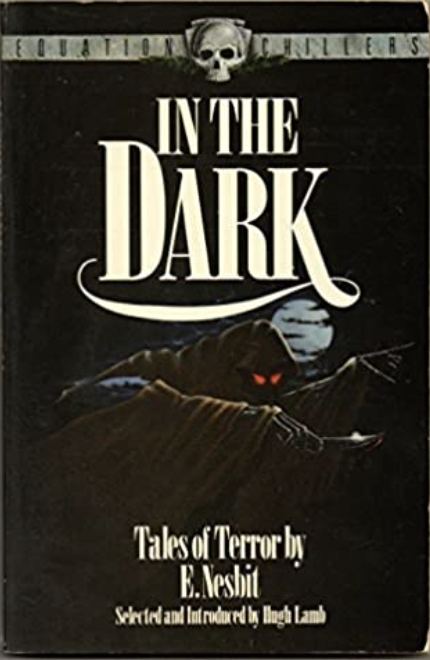
E. Nesbit - The Last of the Dragons / The Magic World / Nine Unlikely Tales / Fairy Tales / In the Dark (various publishers and publication dates)

With all this in mind, and the Nesbitty world of Wished at the forefront of my mind, I shall be reading as many of Nesbit's short stories for children that the days of April (and my collection) will allow, hopefully one per day. It won't be an exhaustive list of every short story she wrote for children but there may be a couple of her tales of terror too - I am intrigued at how they compare!
Abbreviations used throughout refer to the collections in which the stories appear:
TLOTD - The Last of the Dragons, and some others
TMW - The Magic World
NUT - Nine Unlikely Tales
FT - Fairy Tales
ITD - In the Dark (horror stories)
***
April 1st 2022:
The Book of Beasts (TLOTD)
I read this aloud to my class today telling them that this was the Nesbit story I came across as a child and adored. I never forgot it and found it again in the collection I have today when I began teaching. The idea of a Bestiary that comes to life thanks to its previous owner's occult leanings would have absolutely fascinated the younger me and the book-talk with the children today similarly came alive when I asked what creatures they would want to see animated by a magical Book of Beasts of their own, an axolotl being a particularly popular choice and the dodo, which sets off a different line of talk about extinction. The discussion meanders joyfully around this topic for a while then we end up finding a picture of a Thylacine and I recommend Ben Garrod's new Extinct books. I am fairly sure that Nesbit would have appreciated the magic of today's read-aloud session.
April 2nd 2022:
The White Cat (TMW)
'Wicked and Glorious', the partial title of this blog is also the description of an afternoon where Tavy is left home alone (except for the servants, who end up the butt of his practical jokes) but it describes Nesbit's children in general so well. They are naughty but not really bad kids; they are just kids, and quite loveable for all their energies in whatever directions! And this is Nesbit's genius - she really does understand the whims and apparent logic of children's thinking: her writing will never age because of this simple fact.
Apart from the title character being a clearly distant relative of Evans' Attlee with its comic, self-absorbed irony, I am reminded of Wished again, in the very subtle writing about Tavy's mother. She is ill but throughout the story, the family's predicament is only inferred and Tavy doesn't quite understand the full implications. The darkness is there but hangs back. Children live in the moment, or in a Magic World of their own making...real life can just carry on. Evans understands that as much as Nesbit does.
April 3rd 2022:
Accidental Magic (TMW)
Human sacrifice is not something one finds as a plot point in many children's books. But it is here. A kind of weird logic to the story leads from a childhood idyll, sharply interrupted by the harsher reality of school days replete with bullies and unsympathetic schoolmasters, to a bizarre, pagan folk-horror conclusion. I was smiling at Nesbit's characteristic humour at the start, but after a few pages, the tone became increasingly dark, ultimately leaving me feeling quite uncomfortable indeed despite a happy ending...of a kind.
April 4th 2022:
Man-size in Marble (ITD)
In yesterday's story, Nesbit ends by confronting the reader to address their own doubts about whether the story was a dream or reality. Today, in the very first sentence and paragraph of this grown-ups' Tale of Terror, she refers again to the idea of 'rational explanation' and leaves it up to us, the reader, to make a decision.
The narrator, unlike the one(s) from her children's stories, irritated me; a condescending, arrogant man.
April 5th 2022:The Town in the Library in the Town in the Library (NUT)
There are definite hints of Hoffmann's Nutcracker in this tale - the Christmas Eve setting, mice grown to mammoth proportions, toy soldiers come to life, an excess of candy - but the schwarzer-Wald tone has become a thinner, bloodless, 'English' kind, and the macabre creepiness of the original is absent. Or at least, seems to be.
Naomi Lewis points out in Fairy Tales that Fabian and Rosamund are the namesakes of two of her own children. Fabian sadly died at fifteen, she tells us.
There is something sinister about the puzzle-box nature of the children's play in this story: the repetition of 'the library of a house in a town built in a library of a house in a town' is obsessive and odd, as though the story has become stuck, or perhaps that the children's imagination has simply run out. Ultimately, the mouse's deus ex machina advice sorts everything. Lewis says she 'very much likes' this, but for me it rings slightly hollow. Perhaps the knowledge that Fabian Bland (the real Fabian) died in 1900, one year before this story was published in Nine Unlikely Tales, makes me a little uncomfortable.
April 6th 2022:
The Deliverers of Their Country (TLOTD)
As with The Book of Beasts, the acknowledged dragon-nemesis in this tart little satire proves to be a damp squib - 'I can't do anything,' he says - and leaves the way open for the two children to organise the downfall of the invading monsters; I actually can't think of any other authors at the turn of the century who would show up an adult and national hero such as St. George in a book for children. The ignominy!
But this isn't the only bit of ridicule at the grown-ups' expense. The technical wafflings of the children's (oblivious) father, then the professional sparring between him and 'the professor' at the start, hilariously lampoons the field of academia; elsewhere, the word 'taproom' undergoes a brilliant misreading, avoiding the proper, adult definition in favour of a child's fantastic, literal imagining: not a bar but a room with taps that turn the weather on or off.
It's this kind of writing that makes Nesbit a real champion of the children's world. Even the title points to this - the children are the 'Deliverers'...and its 'Their' country too! With Nesbit, the literary tables are turned: she is the first author writing for children, and simultaneously at the adults.
April 7th 2022:
Mélisande, or Long and Short Division (NUT)
There are all kinds of literary references here and the result is the most joyfully bizarre story I’ve read so far. The allusions to Rapunzel and Sleeping Beauty while obvious are all turned upside down, and the disguised attendance of Alecto (I think it's meant to be her) at the Christening, with her snaky hat and bat wings, is just wild!
What is most striking about this story is how it looks far ahead to the work of Joan Aiken. The voices of both authors are so similar - ironic, whimsical, gently mocking, and very, very funny when they want to be. A closer reading of Mélisande, certainly reveals many of the raw ingredients that Aiken was to plunder from Nesbit's larder and make very successfully her own.
First of all, how both writers send up the status quo. In both, there's the regular, topsy-turvy reworking of fairy tale tropes and mythological characters. W.S. Gilbert does something similar in the Savoy operettas though his tone is more satirical; Lewis Carroll plays around with it in Alice, though his caricature seems more suited to the donnish humour of High Table; Nesbit is doing it for her young readers and having a lot of plain, good fun! She is setting a precedent for Aiken, but then also for Jon Scieszka's Stinky Cheese Man, Rick Riordan's Percy Jackson (and his 'Rick Riordan Presents' series), not forgetting J.K. Rowling's entire world of Harry Potter!
But I think Aiken pays subtle direct homage to the mentor who wrote Mélisande. One of Aiken's short stories, called The Apple of Trouble, calls upon Alecto and the other Furies to knock at the Armitage's front door. Aiken introduces her Furies:
'They seemed to be dressed in old-fashioned clothes, drainpipe skirts down to their ankles and cloaks and bonnets rather like those of Salvation Army lasses [...]
then, later:
"We are the Daughters of the Night," one of them hollowly replied. She moved forward with a leathery rustle [...]
and by the morning light, Mark Armitage sees that they have 'snakes for hair'.
Compare all this to Nesbit's description of one of the guests at the Christening: "another fairy in a smart bonnet with snakes in it, stepped forward with a rustle of bats' wings" It's less JA's description of the Furies per se rather than her choice of words - bonnet, rustle - and the fact that the snakes are disguised as part of the hat or, in Aiken, mistaken for 'thick, lank masses of hair' - small but notable nods of admiration.
Other influences on Aiken in this story might include Fortuna, the fairy godmother, whose 'saved' birthday wish turns out to be the crux of all the bad fortune in Melisande. Here, Aunt Gertie (from JA's All You've Ever Wanted) is strongly invoked. We never see Fortuna - she only ever replies (or not!) to the King's letters and, like Gertie with her birthday 'poems', remains comparatively unaware of and certainly at a safe (postal) distance from the severe trouble that her wish has caused.
I'd also mention in reference to the Nesbit/Aiken connection the logical illogicality (or illogical logic) of the Prince's solutions to Melisande's problems:
"How did you do it?" asked the King, shaking Florizel warmly by the hand.
"The simplest thing in the world," said Florizel, modestly. "You have always cut the hair off the Princess. I just cut the Princess off the hair."
That kind of innocent punning sends me straight to Aiken-Land!
April 8th 2022:
The Prince, two mice and some Kitchen-Maids (NUT)
But there were no trips to Aiken-Land today.
A virtually identical opening to yesterday's story, with King and Queen debating how to avoid being cursed at their child's Christening, leads on to a pretty - also, pretty traditional - fairy tale. It's a disappointment and as great a contrast with Mélisande as could be: the dialogue lacks the wit present elsewhere in Nesbit, the fantastic element is humdrum, and even the silliness of the White Rat's putting everything right at the end just feels undercooked.
April 9th 2022:
Billy the King (FT)
The word-play in this story is a delight, my favourite bit being the fact that the Post Office always look after the Royal 'Male' so, on having just become King, Billy is advised to post himself!
But this punning casts a light on a possible something in the title too - is it Billy the 'King'...or Billy the 'Kid'? The Kid's notoriety would have been fairly recent history to Nesbit (he was shot in 1881) so I doubt it's a coincidence, though it really is truly astonishing to consider that she may be alluding to a criminal, in a children's fairy tale. If - if! - her Billy is anything to do with the real-life Kid, then what she has done is to rework the dangerous, outlaw lifestyle of a teenager for her own (littler) hero to flaunt in the face of a corrupt, adult government...And she's writing for a children's audience? Is this allowed??!
April 10th 2022:
The Cat-hood of Maurice (TMW)
This story sets a precedent for a number of other 'transformation' stories. Maurice, the naughty boy who plays cruel tricks on his cat (Sendak's Where the Wild Things Are), later learns from the taunted one to see the error of his ways (Ravel/Collette's fantasy opera, L'Enfant et les Sortileges) by them both swapping bodies. There's an almost identical parallel in Satoshi Kitamura's delightful picture book, Me and My Cat, though in that story we are treated to observe the cat-in-boy's-body's comic shenanigans during the swap.
In Nesbit, though, there's not a whiff of whether this exchange is imagined or metaphorical, as with Max's jungle-island, or David McKee's Jeckyll-and-Hyde Bernard/Monster: with no doubt at all, we appreciate that Maurice has turned into a cat. A moral is present, just not the psychological interpretation (though I guess Freud and Jung were still yet to bring their theories to light). It's a delightful story; and the very touching moments where Maurice gets to learn how his family see him should not be underestimated.
April 11th 2022:
The Queen with the Screaming Hair (A Slice of Rainbow by Joan Aiken)
A delightful, most welcome and very appropriate diversion today. Lizza Aiken mentioned this story to me on Twitter: 'a terrific Aiken steal of [The Cat-hood of Maurice]'. It's certainly got some strong similarities: cruelty to cats' whiskers, child learns the error of their ways; but I also see the typical JA fingerprints all over the evidence! The ultimate, third 'good deed' is completely eccentric and original, and reminds me of the over-the-top finales in the Wolves Chronicles: not even Nesbit would think of an iceberg being pulled in two by rope made from a princess' golden hair. And then for a little, long-lost boat to emerge from inside the frozen chunks? No, that's pure Aiken!
Entertaining bombast such as this aside, the similarities to Nesbit in The Queen with the Screaming Hair open up some intriguing differences too. Aiken takes us over the psychological bridge from Nesbit's moral attitudes into the mid-to-late twentieth century. Not happy with simply presenting 'a naughty child who needs to learn right from wrong' - though this isn't quite what Nesbit is doing either - there's an underlying purpose to Princess Christina's spiteful, talking hair. This part really brought me up short:
"Sometimes the voices gave her bad advice, sometimes they scolded her, sometimes they just teased: 'Think you're pretty? Well you're not - you're just fat and plain!' "
It's Christina's inner self, the reason for her 'unconsciously' cutting off the whiskers, that is given a voice here. How much bad behaviour in youngsters comes from an unfulfilled 'something'? Here, Christina has just been abandoned by her parents - "What have I done wrong?" - she is 'wanting comfort' and without that, her rage breaks out and Christina's guilt and self-loathing builds. Only by submitting to genuine love is Christina (like Maurice, unlike poor Bernard) redeemed. That hair is truly nasty, but it's part of growth (literally, too, in the story!).
Considering two such 'similar' tales, one sees very clearly how different writing children had become over fifty or sixty years. Aiken's story is subtle, but she's not afraid to put this 'hidden' stuff in - she trusts her young audience to 'get' what she's saying. Nesbit started all this, that respect for the young in their literature. She may not have gone as far as Aiken, but my goodness, she passed the already well-developed mantle into very capable hands.
Many thanks to Lizza for bringing this story to my attention today. It has increased my appreciation of Nesbit (and Lizza's mum's stories, too!) a thousand-fold.
April 12th 2022:
The Ice Dragon (TLOTD)
This 'dream/imagination' story I found very strange. There is a traditional fairy tale trope - three good deeds, three repayments - but it rambles on as the children make their journey to the North Pole.
There was also a strange violence to the whole thing with grouse and moths being saved from bullets and pins, and what happens to the 'sealskin people' at the end is pretty revolting. It's noticeable that Nesbit's typical humour is absent - perhaps this made the oddness of the story difficult to stomach.
April 13th 2022:
The Sums That Came Right (NUT)
Today's post appears in celebration of Lissa Evans finding a copy of Nine Unlikely Tales in the London Library!
The jokes come thick and fast today! There's a huge amount of fun to be had at the expense of the useless, impractical nature of worded problems in mathematics: the elliptic descriptions throughout the story which come at a rate of knots - what haunted house? why weren't all the canes thrown away? what about those buttered muffins exactly? - recreate the surreal nature of a page of Arithmetic Word Problems. With a virtuosic subtlety in describing this bombardment of madcap events, Nesbit both manages to side with the child and make any grown-up reading this story realise just how strange the traditional view of mathematics teaching must seem to young eyes!
But the greatest disjunct between the separate worlds of childhood and adulthood comes in the tale's allusions to love and sex. In this way, Nesbit manages to present the surface entertainment of a children's story yet also balance this with a deeper, emotional range that I see more often in Aiken (specifically, in stories like The Serial Garden). It speaks to the reader with humour but also with truth and respect and, for this reason, makes The Sums That Came Right the strongest Nesbit story I have read.
It all begins metaphorically, though. For Edwin, 'love' is not what the Arithmetic Fairy understands and talks about. Early on, Edwin just doesn't get why he has to be put through all these silly stories with calculations attached but the Arithmetic Fairy assures him that the mathematics will be of great use when he is grown up. As she leaves him for the first time, she says,
"Goodbye, my child. You'll know me better in time, and as you know me better you'll love me more."
Ostensibly she means, 'as you get older, all this stuff will become practically useful and thus easier to understand'. Of course, though, other things start to become better understood 'in time' as we grow up...
The innuendo here reminds me very strongly of Stoppard's Arcadia, which itself opens with the young Thomasina asking her tutor during a similar problem-solving lesson the definition of 'carnal embrace'. His literal description of it 'throwing one's arms around a side of beef' could have come straight from Nesbit! There's the same playing around in both The Sums That Came Right and Arcadia with the neat (safe) logic of mathematics and the instability of sexual attraction. Nowhere better is this pointed out in the Nesbit than in this brilliant sentence:
Only one pair of white rabbits remained the property of Edwin, but these, by the power of the Arithmetic Fairy, became ten by Christmas.
(What are these powers - apart from being yet another superb pun! - of the Arithmetic Fairy??!)
Time passes and Edwin grows up. His understanding of mathematics lands him the job of Astronomer Royal and he has posited the Hypernebular Hypothesis, no less. But love and sex are still a mystery to him.
There's an elegiac tone to the ending, the seed of which was sown right at the start when Edwin told the Fairy in all innocence how pretty she is. In the last lines, when he goes out into the rose garden, perhaps to find love finally, the Arithmetic Fairy turns away sadly and flies 'out of the open window and out of this story'. It has the same beauty as the waltz between Thomasina and Septimus at the end of Arcadia - a life that never shall be.
April 14th 2022:
The Island of the Nine Whirlpools (NUT)
A traditional and very charming fairy tale with some particularly notable features.
Firstly the wonderful description, at the start, of the witch's cave - straight into the story with the 'black and yellow fringe of snakes' around the door. Though the witch is not the kind you would expect from such decoration! Then, the snakes themselves become peculiarly delightful with their behaving like 'good Sunday-school children' and awkward attempts at bowing to the Queen as she leaves.
There is a hero (a sailor-boy, 'worthy of a prince') called Nigel which is just lovely!
Later a bit of Carroll-esque logic punning...
'You know a griffin is half a lion and half an eagle, and the other two halves when they're joined make the leo-griff. But I've never seen him.'
...which ends up getting punctured...
'Yet I have an idea.'
...and doesn't have anything at all to do with how the story is worked out. (I like to think this is a slight bit of mockery on Nesbit's behalf, particularly with the contextual presence of a griffin (or is it a Gryphon?) and all the maths that Nigel manages (just!) to solve in order to win his Princess.)
Finally, there's this:
'My Princess,' he said, tenderly, 'two great powers are on our side: the power of Love and the power of Arithmetic. Those two are stronger than anything else in the the world.'
Which, of course, echoes yesterday's story, though here the sentiment is far happier and appears in a more traditional setting. The references to Arithmetic are still curious, though. Curiouser and curiouser in fact...
April 15th 2022:
The Charmed Life, or The Princess and the Lift-Man (FT)
This comes across like the synopsis to a kind of Grand opera in the manner of Donizetti's historical epics! While reading, I entertain myself thinking about the different characters, their singing voices and set pieces - an opening chorus praising the novelty lift ("Possiamo salire e possiamo scendere") maybe? A recitative and aria for dramatic soprano, Candida ("Amo il suo cuore, sicuro e protetto, qui nel mio cuore")? A sotto voce duet, before the final denouement, between the interfering page-boy and the elderly lady-in-waiting ("Non saranno felici, ma trionferemo!")? Although having imagined all this, it's sounding not so far from Gilbert and Sullivan's Princess Ida now.
Anyway, back to reality and Naomi Lewis writes of how the reference to Sherlock Holmes in The Charmed Life is particularly noteworthy as Conan Doyle had only just presented the Great Detective to the public. Nesbit was quick off the mark getting in this reference...perhaps that Billy the King/Kid allusion might not be so much a pie in the sky theory as I first thought.
April 16th 2022:
Billy and William (FT)
Nesbit might so easily have called this, Billy and Harold, to tell us the story is about the two central characters. But she's telling us that it is actually about one boy - Billy (his kinder side) and William (his selfish side). This makes the story so much more interesting when considered in this way.
It's a Voyage and Return story (to use the 'Seven Plots' phrase coined by Christopher Brooker) - Billy, remorseful and wanting to put things right (less, I think, for Harold but more for him), makes his breathlessly incredible journey over land and on sea to the P&O steamer where he finds Harold again. Back they come, together, on the fantastic kite-bike.
Where the turning point for 'William' comes is before the voyage out to the steamer. I'm including a tabulated breakdown of the story, shown against two other Voyage and Return stories, to describe how the Voyage Parts (Orange) are positioned in different places within Booker's 5 Stages model. The red parts are pre-voyage; blue parts are post-voyage) This is not a story where the literal voyage and return mirrors the character's personal growth. In Where the Wild Things or The Wizard of Oz and many other examples - the climactic turning point happens after travelling to the 'other place'; but here Billy/William travels because of his realisation and self-awareness. It makes the kite-bike ride a surface detail; where the voyage and return really is situated is in William's inner character - but then it's there in the title after all.

April 17th 2022:
The Last of the Dragons (TLOTD)
There are some superb descriptive details today: the dragon is twice likened to machines before the final denouement of "How the Aeroplane Came to Be":
It sounded as though a rather large cotton-ill were stretching itself and waking up out of its sleep.
And then:
[...] the clang and clatter of its turning echoed in the cave like the sound of steam-hammers in the Arsenal at Woolwich.
It's a Just So story in all but name, and Nesbit's re-interpretation of Kipling's 'form' (his animal tales were published in 1902) feels a strikingly modern thing for her to have done!
April 18th 2022:
Septimus Septimusson (TMW)
The visual impact here will stick in my memory: the size of the boar ('as big as a horse, with tusks half a yard long'), the frenzied attack of the squirrels on the mole, the jawdropping sight of thousands of mussels swarming to build a reef that will catch the evil fish...
Certainly the part of the story, where Septimus goes forth to break the spell on the princess, is far more panoramic that the other stories I've read this month, and takes the fairy tale form (three good deeds - three repayments again) into some quite spectacular places. It's as though Nesbit were challenging herself to make the characters as eccentric as possible (mussels, squirrels, moles) whilst still holding on to some familiar tropes (wicked magician, cursed princess, enchanted stone). Perhaps it all shouldn't add up, but it does: Nesbit's arithmetic has a magic of its own.
April 19th 2022:
The Magician's Heart (TMW)
Quite a surreal take on the fairy tale, showing me yet another dimension to Nesbit's storytelling. Here she is, playing around with different stories, weaving threads of characters in and out of the tale until everything comes good in the end. There's a 'magic three' (magician, apprentice, princess) which Nesbit somehow manages to square (not exactly mathematically tho!) by aligning the nurse, apprentice, princess...then magician, king, princess...and even 'James', 'apprentice', 'Fortunatus' (one character becomes three!). It's a sort of clever magic trick, like shuffling cards and displaying three-at-a-time, such as in a hand of Find the Lady.
The heart itself is deliciously grisly, particularly when the apprentice whips out the kitchen knife. Nesbit is not afraid of a bit of melodrama here, but also hilariously sends up her own scene as she plays it out:
Stop, I say!’ said James, who was Fortunatus. ‘I’ve got your heart!’ He had—and he held it up in one hand, and in the other a cooking knife.
‘One step nearer that lady,’ said he, ‘and in goes the knife.’
The Magician positively skipped in his agony and terror.
‘I say, look out!’ he cried. ‘Be careful what you’re doing. Accidents happen so easily! Suppose your foot slipped!
A final mention goes to this superb line from early in the story:
[the magician] vanished in a puff of red smoke with a smell like the Fifth of November in a back garden on Streatham Hill
I wondered why Streatham Hill was cited here and looked up the Edwardian connections. Apparently, at the time of Nesbit's writing The Magician's Heart it would have been a very gentrified part of London. The 'back garden' that she alludes to in the simile is, I assume, large; the fireworks going off from it, plentiful and spectacular; hence, the sulphuric splendour of Taykin's exit is perfectly captured.
April 20th 2022:
The Fiery Dragon (TLOTD)
Although the story here (and the rather precious Princess) makes for a winsomely charming example of Nesbit's storytelling, there is a sharp turn near the end: Elfin's hands being burned to charred stumps has more than a whiff of Grimm about it and the ensuing 'remedies' to cure his malady have a darker, folkloric quality about them than the light comedy of the rest of the tale.
The use of the number seventy-seven, as the number of kisses that will bring back Elfin's hands, is an unusual choice, too. It reminds me of Christ's words about forgiveness in The Parable of the Unforgiving Servant. The fact that the Princess cannot quite make up the number (she is one kiss short), seems meaningful - perhaps something to do with the fact that she would always forgive Prince Tiresome, even for all the horrible things he made happen to her.
The hunt with the hippopotamuses ('bad English' according to Elfin!) is pure, throw-everything-to-the-wind whimsy.
April 21st 2022:
The Brothers Grimm (transl. Anthea Bell): The Juniper Tree

Elsewhere the story twists between the grotesque and the downright horrifying: cannabilism, decapitation, maiming...you name it, The Juniper Tree has got it - and certainly lots of symbolism, something far less apparent in Nesbit's reinventions of the traditional tropes: while I wouldn't go so far as to say her tales are much lighter or have less depth as a result of this, they are clearly very much written for children whose own unsullied, burden-less joy in their world is reflected in her style and substance. Nothing weighs down her stories.
April 22nd 2022:
Justnowland (TMW)
Nesbit's children are never caricatures or stereotypes: girl or boy, they are innocent, naughty, thoughtful, wondering. The adults are less sympathetically drawn, like wicked-stepmother-figure, Mrs Staines here, whose punishment of locking Elsie in the attic is excessive and nasty echoes the horribleness of The Juniper Tree (if not quite so bloody!). When Elsie's father returns from India at the end of the story, the quick change of 'Auntie's' character perfectly realises her hypocrisy:
"Come down at once, I'm sure you're good now," she said in a great hurry and in a new, honeyed voice.
Elsie's final "Oh, my daddy, my daddy!" is familiar from The Railway Children; that loving bond between child and parent particularly explicit in Nesbit. In the context of traditional fairy tales, even when the parent/child relationship is positive, there is nothing quite so beautifully captured.
The strange dreaminess of Crownowland is rather 'Grimm', the black feathers of the transformed rich citizens invoking stories like The Six Swans, especially that tale's ultimate image of the boy with a wing instead of arm: there was something in the King's pointing his wing to guide Elsie...
April 23rd 2022:
The Related Muff (TMW)
The narrator here ("I - who am Rupert) is a child, unlike many of Nesbit's other first person narrators. The surface personality is charming but a little affected: the clumsy grammar that Rupert uses to try to sound grown up, the malaprop Gorgeous (=Gordian) knot of awkward conversation that Hilda manages to 'untie'.
The final two or three pages change everything, however. Sidney turns out to be no 'related muff' but rather a hero, who knows exactly how to save Hilda from the very frightening disaster that befalls her. It's made doubly touching that his withdrawal from games and small talk is revealed to be the result of his private worries. The innocent bravado of Rupert's earlier narration feels different after the fire: he has learned something of mortality and danger, and a lot about other people and their worlds. While there is something that doesn't quite work about Rupert's voice, the overall intent and impact is complex and highly original. Although the story is particularly short, there is much here to consider...and to admire.
April 24th 2022:
Uncle James (TLOTD)
Today, Uncle is the baddie (it was 'Auntie' a couple of days ago). Being a magician, Uncle James immediately reminds me of C.S. Lewis' Uncle Andrew, both using their occult learning to realise their own desires. It's the same sinister, slightly eccentric professor-type that nowadays always makes me think of Mr Abney from M.R. James' (another James!) Lost Hearts.
Now that I have read the majority of Nesbit's stories from this collection, I have to admit to being generally a little underwhelmed by her dragons. The one from The Book of Beasts is a particularly majestic specimen but although the others are grand beasts they lack the splendour and impact that I feel dragons deserve. The rather pat solution to the dragon problem (it shrinks in the end) is disappointing. The reverse-expectations regarding the animal sizes is delightful though: riding the guinea pigs like elephants, especially.
The way in which the world of Rotundia is described, especially its inception, reminds me that H.G. Wells (another Fabian) had very recently published The Time Machine, The War of the Worlds, The Island of Dr. Moreau, developing the 'conte fantastique' of Jules Verne and heading towards a Golden Age of science fiction. Nesbit's miniature exploration here is ironic but not sloppy: it has an authenticity that she uses to quite individual ends.
April 25th 2022:
The Aunt and Amabel (TMW)
The opening of a wardrobe and stepping into another world is a very familiar one and I had recently heard of this Nesbit story when discussing C.S. Lewis elsewhere. The focus on 'white' is another snowy connection.
We have an aunt today who is a fine adult who apologises to a child. I found this part completely heartwarming, but also shocking for its place in a children's book from one hundred years ago. Nesbit cleverly puts in a get-out clause for indignant grown-ups though: Amabel can't be quite sure she heard her aunt correctly!
April 26th 2022:
Kenneth and the Carp (TMW)
Finishing the story, I'm struck by how Kenneth confides in Alison, not the two boys who take his side against her. Kenneth's transformation (which has some startlingly good description!) is a turning point for him, of course, but perhaps more so for Alison, whose survival skills won't be quite as self-interested in future: she has learned that actions have their consequences, and they can hurt someone else just as much (if not more...) as they might oneself. Kenneth's forgiveness and Alison's regret are both in their own ways, very touching.
Now that I've read a fair few of Nesbit's short stories this month, I think it's today's kind of story I enjoy the most: a very realistic setting with very ordinary children going about their lives when something is suddenly seen in a different way - magic is not always a necessary part of it - and the children have forever changed, afterwards. The story sits alongside The Cat-hood of Maurice, The Related Muff and Billy and William as peas in the same pod.
April 27th 2022:
Kind Little Edmund (TLOTD)
I quite liked Edmund at the start, particularly his desire to learn stuff they don't teach in school: 'they only know what everybody knows'! But by the end, I could see why others (outside of his family, of course, as Nesbit takes pains to note) found him irritating. The boy's obstinate precocity would undoubtedly be tiresome, but I think Nesbit is once again highlighting the truth that children live in their own worlds and, although such places might make little sense to others, they have their own magic with a logic all of their own.
April 28th 2022:
Fortunatus Rex and Co. (FT)
There's a lot of jokes for the grown ups here, though they feel sly and don't sit well with the style of humour elsewhere. The puns rely a lot on adult phrases turned into fantastic elements or happenings in the story; the political allusions to Tory newspapers and 'cutting up' may suit the business aspect of the King's enterprises but it seems heavy-handed and ultimately only fully understood by the adult reader. In other stories where there is similar punning there just isn't quite the same 'nudge-nudge-wink-wink' quality.
The rambling, improvisatory nature of the telling seems to be an imitation of a parent making up a story to tell their sleepy child at bedtime. The final denouement of Miss Fitzroy Robinson's appearance seemed very sudden, very awkward, rather in keeping with that idea.
One character that almost seems out of place in a Nesbit story for his genuine menace is The Professor. A rather intriguing character at the start, redolent of Carswell in M.R. James' Casting the Runes, he loses steam after his 'curse', despite a quite spectacular and very weird demise. The use of punctuation in his calling card is subtle: he is a PROFESSOR OF MAGIC (WHITE) AND THE BLACK ART, seemingly more into the latter than the former. Menacing, as I say.
April 29th 2022:
The White Horse (FT)
A folkloric flavour to the story today, with a kind of legendary feel too at the very end. The 'penance' for wishing outside of the orchard reveals a fairly disturbing vista of Diggory's old age and also shows him something of inevitable mortality, subtly handled but equally without sentiment or sugaring.
Wish rules are a complicated set of things - they can have an exclusive logic but also an impish, and sometimes chaotic, sense of humour. Here, Nesbit seems to manage both. The reveal of the magician's 'wish-rules' at the end does actually feel nearly satisfactory, despite the wildly unexpected turn of narration: only 'nearly' because there's still that nagging feeling of the plot not having been quite worked out fully - not so much a story but an improvisation - but it's better formulated and spun out than yesterday's, in my view. I think the 'rules of folklore' help.
April 30th 2022:
The Cockatoucan (NUT)
Today's post, the final day of this year's #WickedAndGlorious Nesbit read-a-thon, is in honour of Lizza Aiken's patience, having waited so long to see her favourite Nesbit story appear (and also in celebration of the wonderful colouring-in of the H.R. Millar illustrations in her own copy!
The Cocatoucan is a perfect end to my Nesbit reading this year, as it seems to encompass so much of what I have loved in all the other stories. There is an Aiken twisted-logic to proceedings, so perfectly established and worked-out that the bizarreness of the events, characters actually seems logical; there are hints of Neil Gamain's later urban-fantastic in how the London omnibus drives Matilda and Pridmore to a topsy-turvy fantasy world cursed by the eponymous bird; the regular sly reimaginings of fairy-tale tropes and characters - dragons, princesses...the ubiquitous but slightly out-of-place Prime Ministers!; and prose, ironic but warm, which makes the reading an absolute joy.
One such example stuck out at the very start. Potterer's Saturday Night sounds like a right bore, worse than even the dullest parts of Foxe's Book of Martyrs (mentioned in a previous Nesbit story and just as ominously in Britten's comic opera, Albert Herring). I love Nesbit inclusion of these books, that were written by grown-ups for the edification (and petrification) of children's minds. The author seems just as dismissive of them as any child would be.
But if there can be one final salute to Nesbit, then I must make it this one, a sentence just quite superb:
"Oh, my poor child," said the King. "Your maid has turned into an Automatic Machine." (The fact that it is then discovered that she is an Automatic Nagging Machine just polishes the brilliance to a blinding shine.)
Wicked AND Glorious indeed.
***
Thank especially to Lissa Evans, whose writing prompted this foray into these stories, and to Lizza Aiken, a great champion of "The Fantastic Ironic". Their encouragement and reading of the #WickedAndGlorious blog during the month has been both generous and inspiring.

.jpg)


.jpg)