Sunday, January 30, 2022

Living your best life

 Grandpa Frank's Great Big Bucket List by Jenny Pearson (Usborne, 2022)

In Jenny Pearson's latest novel, as with her previous two books, humour gilds a poignant heart. With all the best comedy, the effect of the laughter is often to make the meaning of its intended subject relatable...even manageable. Great horror writers often employ a bleak, ironic kind of humour to intensify but also to soothe the punch the terrors might bring, for example.  Jenny's books have always made me and my class laugh (a lot!) but also provided us with much to discuss and even more to think about deeply. 

Her latest, Grandpa Frank's Great Big Bucket List, is no exception. The vital place of grandparents in children's lives may be the main message that Jenny so beautifully communicates in this book to her readers, but there is also much to be said about the relationships between others: husbands and wives, friends, and most touchingly, I found, fathers and sons. I won't put in any spoilers here, but Jenny has managed with a lightness of touch to say so much about the grown-ups' feelings and to shine a warm, genuine light on the complexities of being grown up. The children who are lucky enough to read this novel will see much in a completely different way when they have heard Grandpa Frank's story.

And there's another story that Jenny has shared, specially for this blog at the start of the tour this week, focusing on her inspiration for the novel. I am delighted to publish it here. 


Inspirational Albert Absalom

I always like to draw from people I know when creating characters and Grandpa Frank is very much a smooshing together of my own Dad, David, who has a similar dry sense of humour and my Grandad Browne, also David. Yes, the family naming tradition the Davenports have in the book comes from my own family’s inability to be creative when it comes to naming offspring. Dad Frank in the story has an interesting employment history, one which is not dissimilar to that of my Grandad, who spent time as a grave digger, a boiler stoker, a roofer, a hospital porter, steel worker, pest controller and ferret keeper, steeple jack, car mechanic and gardener. He always seemed to have something to sell too.

But the idea for the Bucket List actually came to me thanks to a very good friend of mine, who for her Poppa’s 90th Birthday, along with her mum, set him a challenge of 90 things to do when you’re 90. Albert, who was an incredibly active and sharp gentleman (and not at all crochety like Grandpa Frank), continued working as an accountant for my friend loooong after he had retired, and to me is a real inspiration of how to make the most of life.


During the time that he was carrying out his list of challenges, my social media feed would be full of the most joyous pictures of his escapades. He went all over the country flying planes, racing cars, driving tanks, tried his hand at boxing and even took on the role of James Bond! Whenever I saw one of his photos, I felt I was looking at a man living his best life, and this is a message I try and get across in the book. It is never too late to have an adventure. 

Jenny Pearson


And with that inspirational story now in your heart, I couldn't recommend more than to go out and enjoy Grandpa Frank's Great Big Bucket List! Thank you, Jenny, for your lovely words for this blog, and - of course! - for another wonderful book. 


Grandpa Frank's Great Big Bucket List by Jenny Pearson is out on 3rd February 2022. Do support your local independent bookshops where you can! With many thanks to Jenny Pearson and Fritha Lindqvist in the preparation of this blog. Photographs reproduced by permission. 


Wednesday, January 26, 2022

Agent Moose and Friends!

Agent Moose by Mo O'Hara and Jess Bradley (Scholastic, 2022)

Look out! There's a new Moose in town! 

Agent Moose is a delightful, new graphic novel for younger children - always a good thing, on both counts! - and I've had the pleasure to be asked to interview its author, Mo O'Hara, to celebrate the publication of the book. 

***

I am SO delighted to read a graphic novel that is aimed at younger readers. I just know books like Agent Moose will be widely enjoyed and pave the way to explore graphic novels as they grow up too. The bright colourful pictures and engaging characters really pop out at the reader. But you don't hold back with the complexity of the vocabulary or the humour. How do you see the connections between the written text and the pictures? What do you want your readers to remember and enjoy about the written side of the graphic novel?

I love the fact that you can be a bit more daring with vocabulary choice in a graphic novel than in a chapter book, because kids can glean the meaning of the word through the pictures as well as the context of the surrounding text. Graphic novels are a fantastic way of expanding kids’ vocabulary actually. I think what I want the reader to remember is the voice of the characters. I want the dialogue to be authentic to each individual character so that you can tell that that is an Owlfred line or an Anonymoose line straight away. And I want them to find it funny.

Character really shines through in the book. What makes a great character in a graphic novel?

I think with a graphic novel or with any book you have to really care about a character to want to spend that much time in their head or sitting on their virtual shoulder. Connection with a character is vital for me. All authors and illustrators start their books differently but, for me, it starts with the character. Anonymoose came to me first as an idea and then I built the world, the situations, and the other characters around him. Actually, although Agent Moose came first and very clear in his voice, Owlfred followed along very quickly. Seeing them as a double act really cemented the way that I envisioned the story.

Who is your favourite character in Agent Moose?
I think my favourite character is actually Owlfred. Anonymoose is great. I mean he is a 7-

foot furry moose who is a master of disguise- what’s not to love? But Owlfred brings real heart to the books. He’s an ordinary owl who doesn’t have a superpower, yet he steps up anyway. He uses his brain and his reluctant bravery to get out of tricky situations and he notices things. He is a classic detective who never misses a clue.

Why does Agent Moose work specifically so well as a graphic novel, rather than a standard novel? What drew you to the form for this book?

I think it works because a moose dressing up as a palm tree or a DaVinci painting is just intrinsically funny. We want to see it. There is so much opportunity for visual humour in the story and in the characters. It also works because of Jess Bradley’s amazing illustrations. Every time I get to see a new section that she has drawn there is something fresh that will crack me up.

I was drawn to graphic novels for a couple reasons. I loved comics as a kid. My brother collected comics, so I was literally surrounded by them from an early age. I didn’t read any graphic novels myself until about 10 years ago though. I came across some fantastic storytelling in that form. I used to be an actor before I was a writer, so I’ve always liked visual storytelling. Graphic novels seemed to have this filmic quality to them. They were the perfect combination of visual and written storytelling.

Many graphic novels draw on filmic technique, though in Agent Moose I thought this was particularly strong (such as the cut at the end of Chapter 3 going into Chapter 4!) Did you consciously think visually when you created the narrative?

Thanks. I definitely see the story in a storyboard format as I’m writing it now. I do that with all my writing actually. I think in scenes rather than chapters. For the Agent Moose books though we came up with some clear and consistent ways of showing the story unfold in a very cinematic way. There are establishing shots at the start of each chapter. Sometimes they are a reveal like in the one you describe. There are overhead shots and tight close ups. Graphic novels really reflect cinema and use a lot of similar techniques. But there are also little quirky things that you can do in a graphic novel that you couldn’t necessarily do in a movie like the little boxes in the corner of a frame saying, ‘grinding teeth’ and pointing to Agent Moose’s teeth when he is frustrated or ‘gloating smile’ when Camo thinks he has won. Jess is a master of the visual quirky comic aside.

Can you tell us more about your creative process for Agent Moose? How did the collaborative effort work? How was it different from writing a traditional novel for children?

I set out to write the first script for Agent Moose (and it is called a script for a graphic novel rather than a manuscript) with three things in mind. I wanted it to be like a buddy movie between Agent Moose and Owlfred. I wanted to have a world that was funny but warm hearted, with lots of eccentric supporting characters. And I wanted it to be a proper mystery where you had to follow clues and didn’t quite know the pay off until the end. I went through a few drafts on my own and then showed it to my Agent who showed it to my editor. Then we started working on the script to make it as good as it could be and to really optimise the potential for visual humour. Then it was ready to send to Jess to start to illustrate. Jess had done character drawings already that were fantastic, so she had a great line on who these characters were already. Then the book started to take shape. The art director and Jess honed the drawings and the editor, and I worked on the script more and more. Each aspect fed off each other. I put in lines because of something Jess drew, and we cut things that were unnecessary because the illustrations conveyed the meaning.

Writing any book is more collaborative than most people think, but writing a graphic novel is very collaborative. I learned so much from working with the team that put this book together. And I can’t wait to share Agent Moose -Moose on a Mission with you this summer. Once we had book one under our belts it was even more fun to create book two. We really got to explore the characters and go wild with the disguises. Watch this space.

Thanks so much, Ben, for all your insightful questions. It’s been great doing this interview.

An absolute pleasure, Mo! Hope to see more from the Agent Moose gang very soon!

***

Agent Moose by Mo O’Hara and Jess Bradley is out now!

Saturday, January 8, 2022

#JanMARKuary 2022

Handles by Jan Mark (Puffin, 1985)

#JanMARKuary has, in my mind, become a fixed part of my annual reading as it now enters its third year of existence. I'm delighted to see others join in reading the work and celebrating the legacy of Jan Mark  - their posts and the communal sense of joy in reading is a bright spark during the grimmest month. Many thanks especially to Beth and Roy for their regular involvement and enthusiasm, and of course to Jon Appleton whose knowledge about and encouragement of 'all things Jan' is always warmly appreciated. 

For #JanMARKuary 2022, I have chosen to read a chapter a day of Handles and record random thoughts here in my blog. There probably will be spoilers. There probably won't be many logical lines of thinking. I just want take this chance to record the honest reading of a book by an author I've grown to love.

Jon's exemplary website dedicated to Jan has the details of the book and a few words from the author herself (https://janmark.net/handles-2/); it also includes a link to a blog by Paul May (https://awfullybigblogadventure.blogspot.com/2018/12/jan-marks-norfolk-by-paul-may.html). I try not to 'prep' my reading with too much background information but these two short articles have pointed to a number of 'fingerprints' that I've noticed before in JM's writing: dialogue, a sense of place, real characters. It will be fun to reacquaint myself with that particular voice once more!

As I set out to begin Chapter 1 today, Saturday 7th January, I open my rather battered second-hand paperback copy of the book and glance at the page where Jan signed the book to an unknown-to-me 'Richard'. Her signature is a swirling scribble of biro-ink that despite its potent energy manages at the same time a kind of controlled elegance. One day in September 1985 she held this very book, I think, and suddenly there it is again, just as she manages to do with the words she writes: that genuine connection with her reader.

***

Chapter 1

Straight away we are complicit with Erica. We know the city well ('No, that's the cathedral. This is St Peter Mancroft'). That sense of place again, just a few sketched pencil lines. The town immediately comes to life with its motor-cycle-parks and Castle.

Later, the comfortable strains of family life familiar from other JM stories - Erica's sad feelings about her older brother going away with his friend; mum's clear-as-day wish to have a bit of time to herself during the holidays - but also the deep affection for her characters. Craig, with his awkward height, his desire to become a nurse, despite his father's expected disapproval, and his letting Erica in on mum's secret 'treat', is a particularly lovely example already. 

Chapter 2

The bus journey to Aunt Joan's is a wonderful stream-of-consciousness - the lazy ticking off of the landmarks on her mother's directions, the surnames of the Apostles, the 'uncooked jam tart' likeness of the stop button - making time warp and slow down, just as it does in the feel of travelling from the city out to the rural landscapes of Norfolk. 

JM's wit is embodied in Erica's shrewd observations of Joan and particularly Robert. The visual joke of Mrs Ames quaint little country-fair stall festooned with corn dollies, lavender bags and the Heath-Robinson rat traps is very, very funny indeed and says more about this place than any amount of straight description ever could. 

Chapter 3 

A loving and intensely detailed description of the garden and its (seemingly) abundant flora brings JM's non-fiction picture book This Bowl of Earth, and her own passion for gardening, very strongly to mind. The comedy (that must seem deadly serious to Robert's father) of firing off his rifle at the predatory peacock is brilliantly judged.  


Chapter 4
One of the things I really do love about JM's writing is its macabre quality. She wrote supernatural stories of course, but even those aren't necessarily filled with ghosts of the traditional variety. I am reminded of this reading Chapter 4 today. The weird, witchy touch is there with daydreams of invasive tendrils, fantastic peacocks 'bestride a lightning bolt' (impeccable, inimitable phrase!) and snorting, piggish marrows; there in spades in the description of the freakish moving potplants! JM really does see the extraordinary in the very everyday ordinary. 
 
Chapter 5
When Erica arrives at Elsie's to deliver the letter, there's a noticeable bringing together of two of her interests we have learned about so far in the novel. Her fascination with mechanical stuff, especially bikes, has been evident already; but so too has her care of the garden produce, whether she is consciously aware of her flickering interest in working the land or not. The spots of motor oil are likened to the camoflage used to disguise soldiers 'as plants'. Her bike feels 'more like a cow than ever'. And my favourite of all, the compressor that looks like 'an armoured wheelbarrow for use by entrenched gardeners who had to weed under fire'. 

Chapter 6
Occasionally, in reading, I come across a line or phrase where I think 'Why is that there?'. With a writer as meticulous as Jan Mark, I especially wonder that sort thing when the words are seemingly redundant, there for no real reason. But of course they have been chosen to remain, after all the edits. Today I think this when it is mentioned that Erica would choose to have a white telephone if she were ever to own a mechanic shop. What's that doing there? I don't know...but it feels perfect. 

Chapter 7
JM manages to do so much with so few words. In this chapter there is one paragraph where Robert is rude to Erica and his lip curls like 'a bit of bacon, curling up under the grill'. The simile is crammed with meaning and visual impact, but its the cool continuation of Erica's letter-writing, to finish the paragraph, that packs the greatest punch. 

Chapter 8
There's a rather strange sense of stalling in this chapter. The fact that little happens is neither here nor there in JM - as with Virginia Woolf, Mark knows exactly what she is doing and I would always put my trust in both writers. But the feeling is odd,  the dullness of routine, beautifully described...

Chapter 9
Marrows crop up at the start of the chapter and with the chapter heading illustrations by David Parkins, the same artist who illustrated Nothing to be Afraid of, I am reminded of that fine, weird story in there, Marrow Hill.  

I'm struck again by the many images of green in this book; when I think of Norfolk, it's the wide blue skies and endless sandy grain of the beaches, but this colour lends a freshness. Perhaps in the same way, Erica does too, just as Flora Poste brings a reviving blast to Cold Comfort Farm. 

Chapter 10
As the group of mechanics and bikers and Erica come together, there is a torrent of almost incomprehensible nicknames, slang and verbal jokes. It has a slightly alienating feel to me, as reader. The complicity with Erica that I noted at the start of the book isn't present; she has changed, grown. But I'm not in on the 'handles'. 

Chapter 11
Robert and Aunt Jean have become Dickensian caricatures now that the 'real' characters at the motor-yard have grown. Grubbing over the money - threepence! - Robert is particularly amusing, though the tureen of swede and boiled marrows ends that scene with a flourish of brilliant irony. 

Elsie mentions green and how it was so rare for him to see it growing up.  Also there is the 'double conversation' about inscribing on marrows (the green, natural world) while Bunny, Elsie and Erica discuss the tinkering with the motorbike (the oily, mechanical world). An interesting comparison to that noticed earlier.

Chapter 12
A warm bit of 'old-skool' nostalgia spread through me reading about Elsie's youthful experiences in his teaching job. The Head's charmingly gruff 'appointment' where he hasn't a clue who he is talking to - or why - is very funny. 

Chapter 13
There is much said-but-unsaid in this chapter about Erica's private world. When Mr Bowen (Arrow) disapprovingly picks up on his 'handle', Erica realises 'some handles [are] not for public use'. Elsie's workshop later becomes the centre of over-elaborate excuses about stamps, envelopes and letters, far out of proportion to what they should be. But JM shows us a girl finding herself; Erica has now seen beyond her mum's irritatingly slack grammar and Aunt Joan's self-righteous household. She is prepared to do anything to keep exploring this world of her very own. 

Chapter 14
"She was only a name. She had no handle."

These two sentences point to a deeper level of personal realisation for Erica: there is a difference between a name and who you are. As she stands on the very line between childish anonymity and adult complexity, her frustrations are profoundly felt. 

Chapter 15
Unless I've missed a specific statement of Elsie's age, I've worked out he must be in his late-twenties or early thirties. (Bunny earlier mentioned that twenty years on from the marrow-inscribing at school, Elsie hasn't changed much!) So, in this chapter, the intent discussion about plagues and occurrences (which excludes Bunny) has made me think more about the relationship between Erica and Elsie. He is slightly too 'young' in outlook to be a father-figure but slightly too 'old' to be a kind of brother (and I don't mean age-wise in either case); yet it is these two almost wholly absent members of her family that are brought to mind. Erica isn't missing home and I'm reflecting now on what Elsie brings to her life that is a gap (or two gaps) elsewhere.

And - once again - more green alongside the mechanical: frogs invade the workshop. 

Chapter 16
The reason for the title of the book is becoming gradually clearer - the outward appearances that disguise the real truth; the masks we wear to hide ourselves from others; the personal revelations and re-makings we each go through. In the chapter that ends with Erica noticing the summer coming to a close, the scales fall from her eyes: she is not the same girl she was, nor will be again, and 'no one [has] handles any more'.

Chapter 17
So the marrows ripen fully and, along with a death, there is an autumnal feel to the end of this chapter. I'm reminded of Cold Comfort Farm again in Erica's final reflection: despite all the criticism she knows deep down she has done the right thing. What's worth doing is not necessarily ever easy. 

Chapter 18
The Eroica reference here is apt: groundbreaking music, a symphony turning its back on the status quo, a composer unafraid to shake things up more than a bit. 

But the weight of that handle, that allusion, feels as though it has come too late. This last chapter is sad and almost painfully awkward, with most things seen through glass and odd angles. In my mind, I watch the bus leave Polthorpe Street. There's no answers here, just glimmers of things to come. 
 
***

Jan Mark's Handles was published in 1983 and won the Carnegie Award. It is currently - inexplicably - out of print. 

Wednesday, November 3, 2021

This is STUNTBOY!

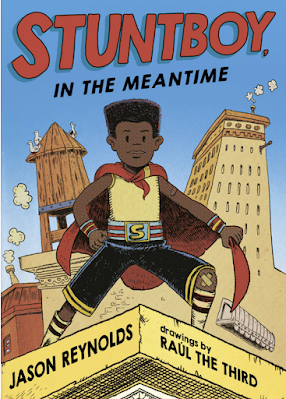
Stuntboy, in the Meantime by Jason Reynolds (Knights Of, 2021)

Reading this book has been an exciting process. Chapter by chapter, I felt that I was reading something quite new. Taking elements of the comic book (it is after all the tale of a superhero!) and the urban fairy tale, alongside Reynolds' trademark-stylish narrative, Stuntboy, In the Meantime is not to be missed. 

Portico Reeves (names throughout reminded me of the improvisational brilliance of Philip Ridley) is the hero of the book, his 'alter-ego' the energetic superhero. We follow his escapades as he solves problems alongside his bestie/sidekick, Zola, battles with his nemesis Herbert Singletary the Worst, and block-parties with the Oldies. Although the narrative whips along, zipping between scenes at a cracking pace, there is a slow-burn, growing fear in the background: Portico's parents are not getting along, separation becomes a potential reality, and the boy's anxiety ('the frets') become increasingly more acute. 

The drawings by Raul the Third are not simply illustrations of Reynolds' story but form a parallel storytelling. It is through these drawings that we slip effortlessly between Portico's real and imagined worlds. We are seeing through the boy's own eyes: on one page, here are his parents arguing relentlessly; a couple of pages later here they are transformed into the 'Super Space Warriors'. In such a way, completely effortlessly, we feel the same pain as Portico as we try to make sense of how these two grown-ups - superheroes to their son - can clash so terribly. 

This book will be devoured by children from Years 5 - 8 as the brilliant story it is. But it would be a shame if you were to miss the intensely immediate language choices with which Reynolds, supreme poet, has garnered his writing. He manages to tap into the very speech patterns that his intended audience use and at the same time turn these to especially original, literary-gold effect: 

His brain started buzzing. His insides started piling and mixing up. His squiggles felt like they were wrapping around his beat box like a boa constrictor. 

And there is the same stream-of-consciousness fluidity in the prose that surfaced in Look Both Ways. Reynolds has this masterful knack of exploring the winding thought processes of children as they try to make sense of the world around them, connecting (and sometimes 'misconnecting') the stuff that bombards them every day. 

But the one thing that bothered Portico about Soup was his name. Why Soup? I mean, maybe he just really liked Soup, which is definitely a good enough reason to name yourself after something. Portico really liked Zola and had sometimes thought about calling himself Zola, but then he figured she wouldn't like it because she didn't even like him wanting to share the Super Space Warriors with her. 

There will be bright recognition and reassuring connection made between young reader and very telling of the tale in Stuntboy. 

Finally mention must be made of the book as a whole. Knights Of not only serve us the very best in terms of literature and new, diverse voices, but they put books out there that are a pleasure to hold and to read. From the design of the typeface throughout (with its nervous energy matching Portico's own) to the choice of including this unorthodox narrative in their booklist, Knights Of once again show they are the trailblazers for some of the best, most challenging literature currently published. They challenge their young readers whilst at the same time supporting and championing them; in short, they treat children with the utmost respect. 

Fast-paced, hilarious, thought-provoking and dramatically visual, Stuntboy, in the Meantime is an absolute gem of a book from a double-act that I hope will produce much, much more.

Stuntboy, in the Meantime is published on November 4th 2021. With thanks to Courtney Jefferies of ed. Public Relations for help in the preparation of this review. 

Thursday, October 28, 2021

Read to Me! (Part 4): Ten Great Non-fiction Books to Read Aloud


I'm a passionate believer in reading aloud to children. It's a regular part of every day for us in Year 6 and I'm more and more convinced that this routine joy for us all is the key to building readers for life, in terms of confidence, knowledge, skills, and of course, pleasure.

Those who read aloud to their classes will undoubtedly read primarily fiction - novels, short stories, poems. Children enjoy listening and talking about these very much and I have also been struck by how they seem to enjoy writing stories for themselves above all other kinds of text. In fact, it was this 'noticing' that led me to explore the idea of reading more non-fiction to my class this year: would they enjoy it as much as getting into a good novel? Would their enjoyment of writing information texts for pleasure be enhanced too? Would the Book Chat be any different to that when discussing fiction or poetry? 

I have in the past always read non-fiction books to my classes  but I have never read whole books  of this kind to the children - why, I really don't know. There is so much high quality non-fiction out there at the moment that it seems silly not to do so! So this half term, I have experimented with reading aloud much more regularly from the same non-fiction book, purely for pleasure, just like a class novel. It hasn't been non-fiction every day; in fact, I have asked the class from time to time to vote if they would like to hear from our fiction or non-fiction read. It varies, as with all our reading habits.

Whilst I am still researching the effect of the practice - and I aim to publish this on the Open University Reading For Pleasure website later this academic year - I hope the following list of books that read aloud extremely well will be of use to anyone looking to explore the richness of non-fiction-reading-for-pleasure for themselves. I would love to hear of how your class responds! 

***

The Ten Books

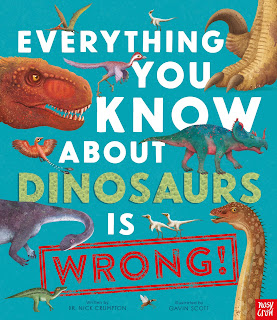
1. Dr Nick Crumpton and Gavin Scott: Everything you know about Dinosaurs is wrong

A marvellously 'dippable' book, each double page spread debunks a myth that children (and many adults, including myself) may have previously believed to be true: Dinosaurs could roar: WRONG! Dinosaurs were all big: WRONG! Dinosaurs are all extinct: WRONG! Excited book chat is an understatement for this one! 

2. Alexis Frederick-Frost : Maker Comics: Grow a Garden!

I discovered this lovely series whilst looking for graphic novels for my class to read. We actually read this one with the children reading aloud each character's part to each other, rather like a play. So many children wanted to join in. The fun, quirky narrative (genius naked mole-rat characters anyone?!) helps to soften the very challenging information about the science of plant growth forming the main intent of the text. Others in the series include Baking and Fixing Cars...but these are just as challenging so be aware! 

3. Helaine Becker and Dow Phumiruk: Counting on Katherine

The Hidden Figures of the Space Race are at last getting their justified recognition and this book, winner of the Information category of the UKLA award in 2020 is a beautifully illustrated and super-clear non-fiction narrative of Katherine's life. The illustrations repay very close attention - there's lots of 'hidden' mathematical references - so once it has been read aloud, I'm sure many children will want to go on to explore the book much more closely. 

4. Kwame Alexander and Kadir Nelson: The Undefeated

This extraordinary book was the winner of the Information Book category of the UKLA prize last year. It is an inspiring and intensely thought-provoking text, equally challenging in its words and in its pictures, and has been the starting point of some of the deepest and most sensitive and questioning discussion I have ever experienced with my Year 6s. The poet reads the book here: https://www.youtube.com/watch?v=_cHIWtl8PNk, a clip I will always show every one of my classes. 

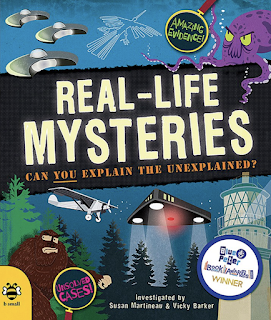
5. Susan Martineau and Vicky Barker: Real Life Mysteries

A bit like a modern-day Mysteries of the Unknown (see No. 6 below), this book riffs on many children's fascination with the esoteric: the Bermuda Triangle, UFOs, spontaneous combustion...and more. The tales are so bizarre that any reading is always accompanied by exclamations of 'No way!'. The structure of the book is perfect with two double-page spreads for each 'mystery': one, an introduction to the mystery itself and its attendant tales, and the second an exploration of two sides arguing whether each phenomenon is fact or fiction. A great book to pick up again and again, it won the Blue Peter Award for Best Book With Facts. 

6. Carey Miller: Monsters

My very first full blog was about the effect that the Usborne classic 'Ghosts' had on me as a boy. There is something universally fascinating and inspiring about this series, thankfully re-released by Usborne. Now all three are back in print and this, the third in the series, focuses on the monstrous, from the Loch Ness Monster and T-Rex to Medusa and the Yeti. The illustrations are pretty horrific and mostly gory, so of course this automatically makes it a winner with most older children! 

7. Ned Hartley and Binny Talib: The Big Book of Dead Things

What a title! This information book that covers everything from mummies to dinosaurs presents one of the most fascinating concepts to children: death. In no way morbid, it offers a lively and pacy exploration of all things dead and extinct by way of a fox family exploring a museum. There are overtones of graphic novel style here that definitely rewards closer viewing, but the text is engaging on a whole class level and the book is exactly what the title says - BIG! - which makes viewing the pictures easy and pleasurable. 

8. Michael Hearst and Jelmer Noordeman: Unusual Creatures

This book that was sitting in my class bookshelves was one that was requested by one of my class to be read aloud to everyone: their amazement at the peculiarities of the beasts described between the covers simply had to be shared. Each page describes a different 'unusual creature' from around the world and the information is couched in quirky structural and linguistic choices: there's True or False quizzes (which engaged everyone!), but also a True or True quiz, for example! I am fairly hardy but the hagfish page, read just after lunch, certainly gave my stomach a bit of a turn. Maybe best read at a different time of day...

9.Christine Dorion and Gosia Herba: Invented by Animals

Like Unusual Creatures, this book has fascinated the children I have taught. An original concept for a book on animals, it explores the concept of biomimicry, specifically how humans are looking to animals and their incredible construction, disguise and communication methods (amongst many other things!) to inspire our own technologies. The page about the mimic octopus led to requests to actually see the creature via a video clip and I particularly love how this book acts as a vehicle for natural further exploration and developed learning. 

10. Markus Motum: Curiosity

The reader-aloud becomes the voice of the Mars Rover, Curiosity, in this complex but beautifully clear picture book aimed at KS2. Throughout, there is a driving sense of wonder and potential making this is the perfect book to inspire the next generation of space explorers, scientists and programmers. 

***

With thanks to Nosy Crow, bsmall publishing and Anna Howarth of Usborne books for their help in preparing this blog. 

Tuesday, October 26, 2021

'The Dark and the Light': An Interview with Richard Lambert


When I read Richard Lambert's The Wolf Road in Autumn 2020, I knew that it was hands-down one of the best books I would have read that year. Particular scenes and characterisation are still remembered with clarity; the way in which animals formed a huge part of the novel and the way in which the author portrayed their uniquely separate world was equally striking.

Now Lambert has a new book out - Shadow Town - and to celebrate its publication, I am delighted to have been able to ask the author a few questions about his writing and the part that poetry plays in his writing life. 

***

Your new book is for a slightly younger audience than The Wolf Road. Why did you decide to write for this age group and was it easier or harder to accomplish?


The age group for the book came from the main character, Toby. I started with Toby – unexpectedly. I was on a train journey and without thinking started writing a scene – about a boy and his dad. This became the scene where Toby says goodbye to his dad that’s in the novel. Toby is a thirteen-year-old boy who tries hard socially but who is constantly getting things wrong and misunderstanding things. I think one of the places he came from was going into schools to do creative-writing workshops and noticing children who misunderstood things or whom the rest of the class group find annoying. And I remembered being like that myself when I was a child. Also I wanted to write an adventure story for children – because I loved those kinds of story myself when I was young.


What is most important to you in portraying young people in your stories?

I feel I have far less knowledge of young people than schoolteachers or parents, so I am constantly questioning myself and whether I’m getting the young characters right. Two things are important for me, though. One is that I don’t underestimate the children’s intelligence – both my characters’ and readers’ intelligence. And the other is that I don’t write a bleak, unhopeful story. I still feel scarred by some of the books we were made to read at school when I was eleven, twelve, thirteen. So I worry that my stories are too dark, and I hope the dark and scary aspects are redeemed by lightness, life and hope, which I try to have in the stories. I want my stories to reflect life, both the dark and the light.

What is the difference for you between writing prose (especially for children) and writing poetry?


I write poems on impulse – so I don’t plan them, and they usually come out short, and usually they are quite personal. But with stories, I plan them beforehand. I visualise scenes in my head before I write. So I can see the place and the people, dimly, like in a dream. And I plot out the stories carefully. When it comes to the writing of prose, the sound of the language is important, and telling the story. When it’s going well, there’s a real flow to it.

The sentences are really important to me, too. With my first published novel, The Wolf Road, the sentences were much shorter, almost staccato at times. They felt to me quite plain. That had a strong effect but I felt that was a lot to do with my writing ability – I wasn’t capable of writing longer sentences. So I spent quite a lot of time after that trying to write longer sentences, and seeing how other writers did that. I wanted something larger, and sentences over which I had more control. I somehow felt I could include more of the world if I could enlarge my technique. And I’ve begun thinking of paragraphs and sentences like little poems in themselves, so I want them to have a shape, and to be interesting on their own terms.

Who are your favourite poets and how do they influence your writing?

I have lots of favourite poets, and they change. But I love John Clare, the nineteenth-century farm labourer, and his nature poems. I love the poems of the Irish poet Michael Longely, for their gentleness. Also the modernist poet Lorine Niedecker, who grew up and lived in a tiny town in Wisconsin in the middle of the last century and worked as a cleaner in the local hospital. The Polish poet Wislawa Szymborska, who wrote warm, witty, and wise conversational poems. All very different.

The sound of words is important to me. When I read, the sound of the language really affects me. Even if I’m reading silently, I’m still sort-of forming the words into speech in my head. And that’s the same for prose as poetry. So I’ll often read a writer if I like the sound of their language. But I think that love of sound in language has been increased by my reading of poetry. And that informs my writing. Also the need for concision. Editing a poem, I'll think for ages about losing a tiny word like 'the' or inserting or removing a comma. So that affects my prose, too. And when reading a poem, it's often the visual image that hits me, so I've become attuned to the importance of the image. The sensory detail.

New readers coming to your writing will find it vivid and starkly memorable: are you a writer more interested in the visual or the aural impact on the reader?

Well, both are really important for me, I think. The sound of words is vital, but I think visually a lot too – I see all the scenes I write. When I'm planning, it's like I am running a film constantly, then adjusting some part of the film – dialogue, actors, lighting, costume – and reshooting the scene.   
But I have thought about this question sometimes myself, what is it that I’m most interested in, and I’ve often thought what I’m less excited by as a writer and reader are concepts, ideas and thoughts. I just feel I have less capacity for that than other people do. And that what excites me is the aural and the visual. That’s enough for me. 

What energises you as a writer and what exhausts you?

I think the thing that energises me also exhausts me – it’s the imagined story and the world I’m creating. It feels like physical effort. Perhaps like a game, or doing some physical activity like playing football. There’s a surge of physical energy, and I follow that in my flow of writing, then I am pretty tired afterwards. Editing is slightly different, it’s just slow, plodding work, and slightly more intellectual, cutting, deciding if something works or not. I’ve got slightly better at not despairing if something isn’t working. I can more easily cut a sentence or paragraph, a scene, or even a whole chapter. But overall it feels physically and emotionally tiring. Like everyone’s work, I imagine, is demanding.

What do you hope young readers remember from your work?

Enjoyment and fun. A visceral thrill. 

***
Shadow Town
by Richard Lambert was published by Everything with Words on Thursday 21st October. 
With many thanks to Richard Lambert for answering my questions and to Fritha Lindqvist for her help in preparing this blog. 

Saturday, October 9, 2021

Writing History: An interview with Frankie Durkin

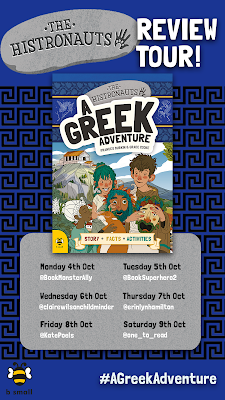
The Histronauts: A Greek Adventure by Frances Durkin and Vicky Barker (b small, 2021)


With The Histronauts now into their fourth outing, A Greek Adventure, it's starting to look like a series that is very much going places. When the first three books (Roman, Egyptian and Viking) were published, I was very excited to see historical fact not only presented in an authentic and passionately personal way, but that it was all couched in the form of a graphic novel! Alongside this, there was diversity in evidence too and a very practical, hands-on feel (there's always recipes or crafts to make), all of which combine to give the series a refreshing and exciting edge over many other history books for children.

These books are a real gift to teachers, but what has really fascinated me as a Writing Teacher is how do we education professionals best help the young people in our care to think, read and write well about history? So it's been a huge pleasure  to have been given the opportunity to ask Frankie Durkin about her feeling for the past and how she writes history. 

***

Hi Frankie. I’m interested to know more about how history became such a passion for you. Can you tell us what was the first time you knew history was going to become a big part of your life? 


Hi Ben. I really don’t remember a moment when history wasn’t in my life. It was always firmly in the foundations of my childhood thanks to my parents and aunt. From day trips to museum outings to books to documentaries and TV shows. There was always so much history on my doorstep and kids in the UK are so lucky to grow up in a place where the past is such a key part of the landscape and tourist industry. There are places to visit and stories to learn wherever you are. The smell of the Jorvik Viking Centre is really nostalgic for me and the research visits for The Histronauts’ Viking book a few years ago brought back a lot of happy childhood memories. I also became fascinated with ancient Greece after spending an afternoon watching Clash of the Titans when I was about eight and I read everything I could get my hands on, even Homer. And I remember Mum having a book that tied in with a mock trial of Richard III that was staged by Channel 4 back in the early eighties. That led to another obsession and I actually wrote to my MP about exhuming the bones of the Princes in the Tower from Westminster Abbey. But I don’t remember ever having a moment when I thought that I would become a historian. I didn’t even study it formally until I started my master’s degree. But I love it. I love asking questions and finding out about the lives of people who lived such a long time ago. It felt like a natural progression to do my PhD and keep doing something that I’m so passionate about. But I never dreamed I could be lucky enough to be sharing history with young audiences quite like this.


2. Which historical periods have particularly fascinated you personally? What is it about them that grabbed them so much? 


So ancient Greece and The Wars of the Roses were very big early influences, but the Middle Ages has been my longest fascination. I grew up close to medieval castles and cathedrals so they definitely shaped what I was most interested in. I also like to blame Robin Hood: Prince of Thieves. But those familiar old buildings and city streets always inspired me to look for answers about the history and what life was like for the real people who built them and lived in them. And that’s what carried me into my doctoral research and the reason I became a medievalist.


3. In choosing to write for young people, what did/do you want to capture to engage them in a similar fascination in history to your own. 


My own love of history started, and was nurtured, when I was very young. I don’t really recall it being something that I thought of as a chore or even a subject to learn. It was just something I was very interested in and always wanted to find out more about. My parents gave me the freedom to explore what I wanted to, and I loved finding out new things. But I’m not unique in that respect; so many historians talk about a childhood love of the subject or a particular topic that captured their imaginations and stayed with them through to adulthood. I think it’s natural to want to be a part of igniting that spark for new generations and I really want to help create those lifelong passions for history in our readers.


The Histronauts themselves are the most important element for engaging our readers. We created a group of friends who want to explore and ask questions. They love to go on adventures and they definitely want you to come with them. They don’t just want to be told what the past was like, they want to discover it for themselves. We really want everyone to be a part of their gang and to learn alongside them. 


4. What do you find to be the most challenging aspect of writing about history? 

Oh, that’s easy; what to leave out. It doesn’t matter if I’m writing a book for children or a research paper for a room full of medievalists, there is always more to say than I ever have time or space to include. Making the decisions about what makes the final edit and what doesn’t is so difficult. I honestly can’t imagine that any non-fiction author doesn’t have the same problem. When it comes to writing The Histronauts that decision is sometimes helped by the fact that some things are just not appropriate for a young audience. But a lot of research goes into these books and so many wonderful facts or stories don’t make it into the final edit. I am lucky that some details can be used in workshops or teacher notes that support the books but, ultimately, I hope that The Histronauts inspire our readers to find out more for themselves and that they are a steppingstone into whole new worlds of all the things that didn’t make it into the books.


5. I’ve found when children write about history it’s important to show them to take a specific focus. How do you select what to include/write about when presenting huge topics such as “The Greeks” or “The Romans”?

That’s a great question! The structure of the books set out a lot of parameters for what I decide to focus on. The Histronauts spend a single day with a person from a certain period so choosing the point in time that they will experience helps to give the books their focus. Some of our books look at subject areas that refer to thousands of years of history and I take care to pick a point that gives us a wealth of information and allows us to discuss what had happened earlier. A good example of this is from our book about ancient Egypt. I wanted to set it during the construction of the pyramids but this happened relatively early in the timeline of what we call ‘ancient Egypt’ so it limited what our characters could talk to each other about. However, by shifting the setting to the Valley of the Kings in a later period we could still acknowledge the pyramids and take advantage of the stunning archaeology from Deir el-Medina where the craftspeople who built the tombs lived and worked.


The individuals who serve as The Histronauts guide also gives us an anchor to work around. In previous books we have met the daughter of a Viking boat builder, an Egyptian priestess and a man enslaved by a Roman General. In A Greek Adventure we meet a theatre propmaker who introduces us to his work, his family, the things he sees and even the things he eats. We wanted to make a deliberate shift away from experiencing the world through the eyes of kings and queens. Instead, our key characters are ‘ordinary’ people who give us an insight into how any one of us might have lived during that period. So, although the book does contain broad information about different classes of society, we want to show people that our readers can relate to and imagine themselves interacting with.


Our intention is always to take a vast topic and focus on how a person occupied their own place at a point in that time. We then build around them and allow The Histronauts tell us more about the bigger parts of that world. 


6. In your opinion what does the format of The Histronauts series do for children’s love of history AND love of reading for pleasure? 


Graphic novels are such an exciting format and I’m so delighted to see so much discussion about them between creators and educators on social media (I know you’re a big part of this discourse Ben). Visual literacy is such an important skill for all book lovers to develop, no matter their age or reading levels. And I really hope that readers who aren’t always confident with pages full of text feel that our books are a welcoming place for them to have fun learning about the past.


I’m so in awe of the visual elements of these books and it is such a privilege to be a part of the team that makes them. The brilliant illustrations are done by The Histronauts’ co-creator, Grace Cooke, and the layout is designed by b small publishing’s fantastic Art Director, Vicky Barker. We use images to communicate a lot of historical information that I could not include in the text. The visual details are always the very first starting point for our research and Grace and I always begin with museum trips so that we can see the tangible elements of the worlds we want to explore. We find so many things that we want to incorporate and it’s amazing to be able to create such an inviting version of history that appeals to all kinds of readers. We’re also able to use images as a method of telling the story and developing our characters; we love sneaking little jokes or details in that you might not see on your first read through. It’s a wonderful medium to use and gives us so many layers for our readers to engage with.


7. Inclusion and diversity is vital in today’s books. How do you address this hugely important topic in writing about history for young people? 


It’s enormously important and there are lots of ways that we try to make our versions of history more inclusive. As I mentioned earlier, it’s important to me that we don’t limit our account of the past to one of the ruling classes. I think it’s really reductive to perceive the past only through the eyes of the wealthiest people who lived then, so we want to challenge that. We also always want to counter perceptions of what people in a certain time and place might have looked like. We want to show that people of colour lived in ancient Greece and were a part of the Roman Empire, it’s important to see that Vikings were not all blonde-haired and blue-eyed. The past was an enormously diverse place so we are determined to represent that and give our readers something to talk about.


8. Having known very little about the history of ancient Baghdad myself when I first came to teach it to my Year 6 class, I was so excited to learn along with them! Which historical periods would you love to see become more of a focus in schools, primary and secondary? 


Oh, there are so many! Personally, I would love to explore more about African history; I’m reading a great book about the Benin Kingdom right now and it’s making me very conscious of the scale of that gap in my knowledge. It’s exciting to start to remedy that! But as well as widening the global span of what we study, I’m also passionate about teaching different aspects of what we already learn. British history has been too narrow for too long and we are a nation full of cultures whose history deserves to be celebrated. There are so many diverse writers and historians who are now writing histories that have been hidden away and it’s really exciting to see the growth of important narratives that have been neglected for so long. Organisations like The Black Curriculum and The National Trust are doing amazing work to expand the way we look at the past so we should embrace their work and welcome them into our classrooms. 


9. And finally as a passionate historian and educator, a big question - what is the point of learning about history for young people?


A massive question! How long do we have?! I could give you so many reasons that are about studying the past to understand the present or seeing the political patterns that shape our society. But if I really have to sum up why I think young people should study history I would pick two areas that are most important to me: critical thinking and empathy. As a historian it’s so important to learn how to think critically and to assess the evidence that you work with. It’s crucial that children learn to question everything and history encourages them to do exactly that. And I want them to feel empathy for people who lived long ago. Whether they’re studying war, or royalty, or industry, or any aspect of history, I really want them to think about the human aspect of it. I want them to want to understand that history isn’t just dates or statistics, it’s real people, just like them, who lived and loved and struggled laughed and learned. Whether it’s their great-grandparents’ experience of migration or a local story about the coal mines or a stately home they visited on a school trip, everything that can be labelled ‘history’ has an important human story. It’s why I’m a historian.