Friday, January 1, 2021

Unexpected Discoveries - The Short Fiction About Teenagers by Jan Mark

Last year was off to an excellent start in my personal reading: a whole month of Jan Mark's short stories - thirty stories from thirty years of writing as Jon Appleton's glorious collection, The One That Got Away, pronounces on its cover. #JanMARKuary was set up on Twitter to celebrate Mark's outstanding contribution to writing but her voice continued to speak to me throughout the ensuing months, with readings of The Hillingdon Fox and a selection of some of her shorter works for much younger children.  Now, here we are a whole year later, in January 2021, returning to this extraordinary writer with a second outing for the hashtag. Hurrah!

Throughout January, my own project is to read more of her short stories, this time those that focus on teenagers. I will be reading through these, in alphabetical order by title - there will be one story to read, most days. I'll be adding to this blog day-by-day with a short comment on something that strikes me about each tale, generally following the prompt posed on Twitter but without the restriction of character-counting.

It's going to be interesting to see how these stories connect, compare, contrast with those read last year and also with my deepening appreciation of Mark's unique, extraordinary writing and process generally. She always manages to surprise me, demonstrating the literary equivalent of a magician's sleight of hand: I finish her books and stories with a unique feeling of complete satisfaction, never ever really wanting to know 'how she did it', though. I'd rather simply sit amazed and applaud,  then turn eagerly to the next JM on the list!  

I don't know what to expect this #JanMARKuary. The one thing of which I can be certain, though, is that (as the Sunday Telegraph said of her collection, A Can of Worms) it's going to be another month of 'unexpected discoveries'.

***

Note: Abbreviations used throughout refer to the collections in which the stories appear.

ACOW  - A Can of Worms
DYRM - Do You Read Me? 
F&OS - Feet, and other stories
FH - Frankie's Hat


January 1st 2021:   

A Can of Worms (ACOF, DYRM)

Who is the main character in this story and how do you know?  

Although Dora takes the role of viewpoint throughout, it is Gran who emerges as the central figure, only really identifiable as such when, with typical Markian 'ta-daaaaah' revelation, the last few words draw out an invisible bundle of threads from that eponymous 'can of worms', that leads us to properly consider the older woman's inner life: friendly, candid, impersonal, no guilt, nor duplicity nor recognition. 

Elements of Jan Mark's own personal life and loves appear cameo-like throughout - books, the joy of gardening, working in charity shops; another invisible' life in addition to Gran's - even hinted at by a fleeting phrase in the story - 'hidden in plain sight'.


January 2nd 2021:   

A Little Misunderstanding (F&OS)

Where is this story set? 

The majority of the story is set in a chapel where a visiting preacher makes a particular impression on 'Kipper'. The opening of the tale cuts between different points in time and different places too - a car, an 'embalmed sitting room' (a perfectly precise description!), some bike sheds - but I found it a rather confusing way to present the exposition. The actual scene in the chapel, however, is both hilarious and terrifying while the ending has a curiously threatening atmosphere. 

A very unusual story both in structure, tone and characterisation. 


January 3rd 2021:  

Closer than a Brother (DYRM)

Is the story mostly about character, setting, or plot?

Sly, darkly funny, with a distant vein of melancholy, this tale is more Alan Bennett monologue than traditionally-styled short story. The writing never quite hits on a plot although there are occasional hints and diversions that signal attention away from what's really going on. No, it's all character here; the narrator (un)wittingly gives away more and more about themselves whilst at the same time keeping us wondering about their true motivation for actually telling us this story in the first place. 


January 4th 2021:  

Crocodile Time (ACOW)

What feelings did you experience when reading today?

The bravado shown by the two boys is very funny in this - a teenage Batman and Robin double-act in tourist-time Oxford! 'Magdalen Man' - with his pretentious 'It's Mawd-lin not Mag-da-len' - also made me laugh, but this time 'at' not 'with' him. It was only at the end - and once again with JM, I had no idea what was going to happen right up to the very last line - then the rug was pulled from under my feet and the entertainment froze: in a flash, the story became a poignant last look at the carefree children-that-were before the grown-up view of life finally takes hold.


January 5th 2021:   

Do you read me? (DYRM)

If you could illustrate this story, what would you draw? 

I have a soft spot for badges myself and like JM's son (for whom she bought them) I have a collection that I don't much wear. The variety of the badges, their collective portrait of the main character, would make a good picture - a kind of collage of all of them and one (would the reader look closely enough?) to have the minuscule words written around the edge. 


January 6th 2021:   

Enough is too much already (F&OS)

What does JM want the reader to remember most from this story?  

Dialogue is at the forefront of this story - which is actually a storyteller explaining himself to his friends. The sharp flavour of the speech throughout conjures up the inner and outer worlds of the three characters, Nazzer, Maurice and Nina, better than any description could. JM's last line is interesting here - not a surprise in itself as it simply brings to an end Maurice's almost interminable story that started all those pages ago. And what a story: its winding, meandering lines and ultimate pointlessness beautifully mirrors Maurice's railway journey itself: a kind of Beckettian 'nothing', the sort of happening that occurs from time to time in life, and which teaches us that not every moment can be packed full of interest. The (subtle) delight is that Maurice thinks it's so awfully important; Nazzer and Nina, however, clearly don't!


January 7th 2021:   

Feet (F&OS)

Would this story make a good film? 

No, I don't think so. The reason is that although there's a miniature comedy of manners going on at a surface level, a lot of the story is about Jane's internal world; she keeps her feelings close in a kind of stream-of-consciousness haze. A film would do little justice to JM's intentions here.  


January 8th 2021:   

Do the stories have clear 'goodies and baddies'? 

JM's writing is far too nuanced and subtle to have something so obvious as 'goodies and baddies'. In Feet there's an arrogant youth but hardly a bad guy, the trio in Enough is Too Much Already are simply themselves, neither good nor bad, while Gran in A Can of Worms, although very mildly villainous, actually engages us in siding with her! It's more a question of perspective. We might look at what JM is telling us and consider it from multiple angles: a alternative slant of light would reveal a completely different story with very different characters. Quite true-to-life in fact. 


January 9th 2021:   

Frankie's Hat (FH)

What alternative title might you give to this story? 

I'm going for a direct quote from Frankie herself: 'What do you take me for?' One of the last lines directed at her confused sister, it sums up not only the fractured relationship between Frankie and Sonia, but also underlines the older girl's frustration with herself - even the return of her husband only goes to emphasise how distant and lost the real Frankie has become now. A really very sad story indeed. 


January 10th 2021:   

Front (DYRM)

Which was your favourite moment in today's reading? 

Unusually for JM, I found this story a bit long-winded, the opening especially; maybe it was me but the descriptions of the gardens at the start felt overworked, and the story itself was lacking generally. My favourite bit was the moment where the narrator says that she finally understands the purpose of 'small talk' in grown-ups - one of those 'penny-drop' moments that accompanies the move towards adulthood. 


January 11th 2021:  

How would you describe JM's authorial voice from what you've read so far? 

There's definitely a subtle shift in tone with these short stories for teens, compared with the ones for the older juniors and newbie secondary-age children. Although the humour is still there, it's far more wry and ironic, less playful. She has the same sharpness in the dialogue, though there's a laconic tone too. In a couple of the stories, she pinpoints real empathy - which she also has in the stories for younger children, but here she opens the readers' eyes up to more troubling 'grown-up' concerns: Front in particular, and the endings of A Can of Worms and Crocodile Time. Mark - as always - is firmly on the side of the young.


January 12th 2021:  

Whose writing today is in the Jan Mark lineage ?

Most definitely it's Hilary McKay. There's the same tone in the language (if not quite in the plot or storytelling); the same qualities that both writers highlight are at once sympathetic to and celebratory of their young protagonists; and the humour is often quite prickly and couched in reality - never corny, never careless. I think I know now why I loved The Time of Green Magic so much - it's exactly the kind of domestic fantasia that JM might have written. 


January 13th 2021:  

I was adored once too (F&OS)

If you could interview a character from the story, what would you ask them and why?

I'd ask Birkett why he repeated the line from Aguecheek with different intonation - what had he realised? - the lynchpin moment that not only turns the story itself, but also the point where the boy becomes shudderingly aware of the implications of adult-world interactions. A witty and enjoyable story but this moment of pain was a difficult pill to swallow. 


January 14th 2021:  

It wasn't me (FH)

Which character do you like most?  

Tricky question to answer with today's story (although it was superb!). Chloe may be condescending and Mum far too submissive and accepting of the status quo, but Ronda came across to me as very edgy, tight-lipped, boiling up towards an explosion. Which of course, is the whole point of the ending - another of JM's absolute 'nailed it' moments. I admired Ronda's courage rather than 'liked' it, I think. 


January 15th 2021:  

Just passing through (DYRM)

What message do you get from your reading of JM so far?

Oh, it's that life is so strange! Yet we notice so little in our day-to-day routines. I love how JM does notice these things and dissects them with gruesome fascination, laying it all bare and showing us what truly lies beneath the skin. The humour of the stories for younger readers, I'm noticing, is still very much there in the stories read this #JanMARKuary, but the laughs are slightly more bitter, hollow or - as with this masterly bit of supernatural yarn today - they're unsettled and nervous. 

Half-way through this month of JM reading, I'm astonished yet again by her variety, breadth and depth but also her remarkable consistency in tone and quality. 


January 16th-17th 2021:  

Like it is round here (FH)

What do you make of JM's dialogue? 

The dialogue between Mum and Yo-yo is perfect: the older woman comes across as a critical friend; her daughter on the other hand is full of barbed sarcasm but - as the last two sentences make very clear - Yo-yo is so glad to have her mother. The sly smiles they exchange, the 'speaking clock' interrupting the phone calls, the exasperated frustrations all couch Yo-yo's development as a young woman in a realistic and supportive relationship. The absence of Dad draws the two female characters even closer. Partly emphasised by the attention drawn repeatedly to Robert's  'Uh-huh'-ings too, JM uses her dialogue to build the contrast between male and female outlook quite brilliantly.

Have you read anything else like this story?

Nothing is like JM in any reading I know. She's a complete original; although you might find traces of her interests and style in writers like Anthony McGowan (The Truth of Things), Hilary McKay (The Casson series, The Skylarks War) and Richard Lambert (who comes close with the very authentic - but much, much darker - depiction of rural teenage life in The Wolf Road),  I can't think of anyone who quite matches the tone of JM's writing: a mix of sharp, bountiful humour and soft sensitivity that is totally unique.


January 18th 2021:  

Mrs Tulkinghorn's First Symphony (F&OS)

Are JM's characters believable to you? 

In short - believable characters, yes, though Mrs Tulkinghorn's First Symphony calls for me to qualify my answer and think harder. Here, JM creates a rarefied, dreamlike, and - for a fraction of a second - quite threatening atmosphere where we seem to see the story from inside her characters. It's something I notice I've mentioned before (in Feet): there is realism but it's on a different plane - the real world seen through the eyes of the character. Oddly, in this story, it's not the boy's eyes we see through, but Mrs Tulkinghorn's. It's an unsettling feeling; but then - now I think about it - I've not read a single thing by JM in these stories that hasn't got that edge, somewhere. Life 'through a glass darkly' perhaps? 


January 19th 2021: 

Which part of your reading has stuck in your mind the most forcibly? 

Tiny snapshots: the theatre group standing around at the end of I was adored once too, the damp rising ominously in Just passing through, Gran looking inquisitively through the window in A Can of Worms. I'm not surprised that JM likened the writing of a story to a picture  and the action going on within and without the frame. This 'photo album' of her tales is full of vivid shots.


January 20th 2021:  

Party Wall (ACOF&OS)

In your reading of JM, what do you think interests her as a writer the most?

I originally posted on Twitter that I thought it was 'inner and outer lives' and I still think that is integral to JM's outlook on writing; she has this way of revealing the most extraordinary things about her characters in the most ordinary of contexts - it's like she is saying "Here's the everyday lives we all know, but look closer! What's really going on?" But the more I've thought about this, it's also about perspective. Party Wall demonstrates this beautifully: we see an ordinary street and two ordinary houses; the characters are all the sorts of people we know but here they are, connected by a 'party wall'. The elliptical, partial reveal of the students' life stories casts mystery and we readers feel both pain and guilt at our trespassing on the personal. Note the window at the end: looking out and looking in: what before seemed a quite everyday 'outer' life reveals an 'inner' one that now confronts us. An intensely haunting experience.


January 21st - 22nd 2021: 

Poor Darling (F&OS)

Which character have you liked the least? 

Was there anything you disliked about today's reading? 

I like 'dislikes'. Too often, etiquette demands an overly positive attitude to things we've read, but there is so much of importance in identifying the stuff we haven't enjoyed. Today's story is masterly but I don't like it. It's very, very uncomfortable, and the horrible revelation at the end - again a painful discovery - is another example of JM's laying out of the stark differences between our inner and outer lives. And the characters I like least? It's the two strangers who've just only met but find balm for their personal hurt in nasty, covert whisperings.


January 23rd 2021: 

Posts and Telecommunications (F&OS)

How does the main character feel in this story?

Hurt. Abandoned. Lonely. It's a painful experience. This year, I'm seeing a lot more bleakness in JM's writing and in some cases, a lot less hope. Her characteristic endings, always a surprise, can also cast some dark shadows indeed.


January 24th 2021: 

Resurgam (DYRM)

Which character interests you the most?

Michael: his quiet subversion. The ending is odd though - I have a strong feeling that it's Michael who has created the 'black magic' - his talk of 'the place of skulls' and Judas' noose earlier is quite macabre, though actually more 'realistic' than primulas and daffodils - but is it really him? JM deliberately casts his final words of the story with no clue as to his expression... Elsewhere, there were hints to me of Hardy's The Choirmaster's Burial here: the hypocritical church-goers and their bloated self importance contrasts strongly with the far more Christian outlook of the vicar's son. I liked this story a lot.


January 25th 2021:

What surprises do JM's books and stories have?

The endings are always brilliantly surprising. There's only a few of the short stories that don't suddenly twist the whole narrative with a few words. Even once you've read a few of JM's tales, and you semi-expect there to be some kind of surprise at the end, you can't predict it. Although I haven't re-read many of JM's short stories (yet!), I have a feeling that doing so doesn't diminish the flourish of the ending.


January 26th 2021: 

Still Life: Remote Control (F&OS)

Is the setting important to the story?

An art room provides the setting in this story and forms a kind of metaphor for what's going on. In Lockdown, I'm finding that the near-emptiness of school is such a contrast to the buzzing, tremulous, uncontained energy that fills the building when the children are all there. JM manages to capture this feeling in all her stories - a pulse that drives the life within. But like a classroom (as with the art studio here) the overall buzz is created by individuals, and by focusing on the differences, firing attention from one young person to the next, JM points to this fact. Here is the energy of the classroom; here too is the energy of her stories. 


January 27th 2021:

Would you read other books by JM?

Yes. Anything I've read by her is so completely different to everything else she writes; I'm amazed by her Protean gift and it makes reading her an absolute joy.


January 28th 2021: 

The Gnomon (DYRM) 

Was there anything that puzzled you in today's story?

Another ghost story today. JM plays by the rules in her supernatural fiction, I find: these stories are pretty traditional in their telling, and (with the notable brilliance of Resurgam) leave the reader with few questions oddly enough, considering the genre! However, while I was slightly disappointed by the eerie tales from In Black And White, those I have read this year have been much more successful - the ghost's suppressed hatred and its brutality is particularly striking here.


January 29th 2021: 

What are JM's frustrations?

Something about her work hints at a frustration with those who only see the surface; and with those who don't think beyond that surface; and with those who can't (or won't) see the mystery that is life. Everything she writes seems to focus on the ordinary but seen through a lens than manages to reveal the extraordinary, the unsettling, the un-everyday. In her stories for younger readers, this often became the source of their humour (like Anthony's challenge and triumph in his mocking, hysterical laughter from How Anthony Made a Friend); but in these stories about teenagers, the humour emerges completely differently - laconic, ironic, quite deadpan. Is JM completely serious about being funny? Or funny about being serious?  

How this links to her 'frustrations', well, there's more to be said about this, I can sense it, but that's as far as I am able to go for now. 


January 30th 2021: 

The Travelling Settee (ACOW) 

How did the main character change in the story?

A GCSE assignment to write about an interview with a favourite author turns into something much more revealing about the subject and the nature of writing itself. We see, step-by-step, how the author of the narrator's beloved childhood books learns what it was truly that 'made' the story, and we learn too what writing, and all its mystery, can do. He changes in the space of one short interview, learning finally what writing those books meant to him. 

This is a beautiful story. 


January 31st 2021: 

Too Old to Rock and Roll (DYRM) 

What did you think of the ending?

It's the last day of a fairly grim January, but it's been a glorious #JanMARKuary and now I've reached the end, what were those promised 'unexpected discoveries' in my reading of JM's stories this year? 

I'm struck most by how different the ones about teenagers are compared to those written about younger children. There's a darker feel to the atmosphere, humour is still there but the slyness has now turned mordant. There is ebullience in her characters, but there's now a layer of anxiety too. I feel I've been journeying the hinterland that exists between childhood and adulthood - a strange place indeed. 

It wouldn't quite be right if I identified 'favourite' stories this year, because they haven't felt like that: while I have loved reading them, these stories have challenged me much more than the more well-known ones for a younger audience. I don't want to love everything I read; I like that about reading and about Jan Mark's writing in particular, I'm finding.

But...there are a few stories that have 'stuck' in my memory and feeling though and for various reasons (none of which the same) I must mention A Can of Worms, Crocodile Time, Do you Read Me?, Poor Darling, and Resurgam.  

So. It's the last day of #JanMARKuary 2021 and I'm particularly pleased that the last words of Too Old to Rock and Roll - the last I read for this year's celebration of JM - both neatly wrap up the story and provide a kind of looking forward: 

"There is still so much more to come," they seem to say. "It's not over yet!" 


Wednesday, December 23, 2020

Incredibly Smashing

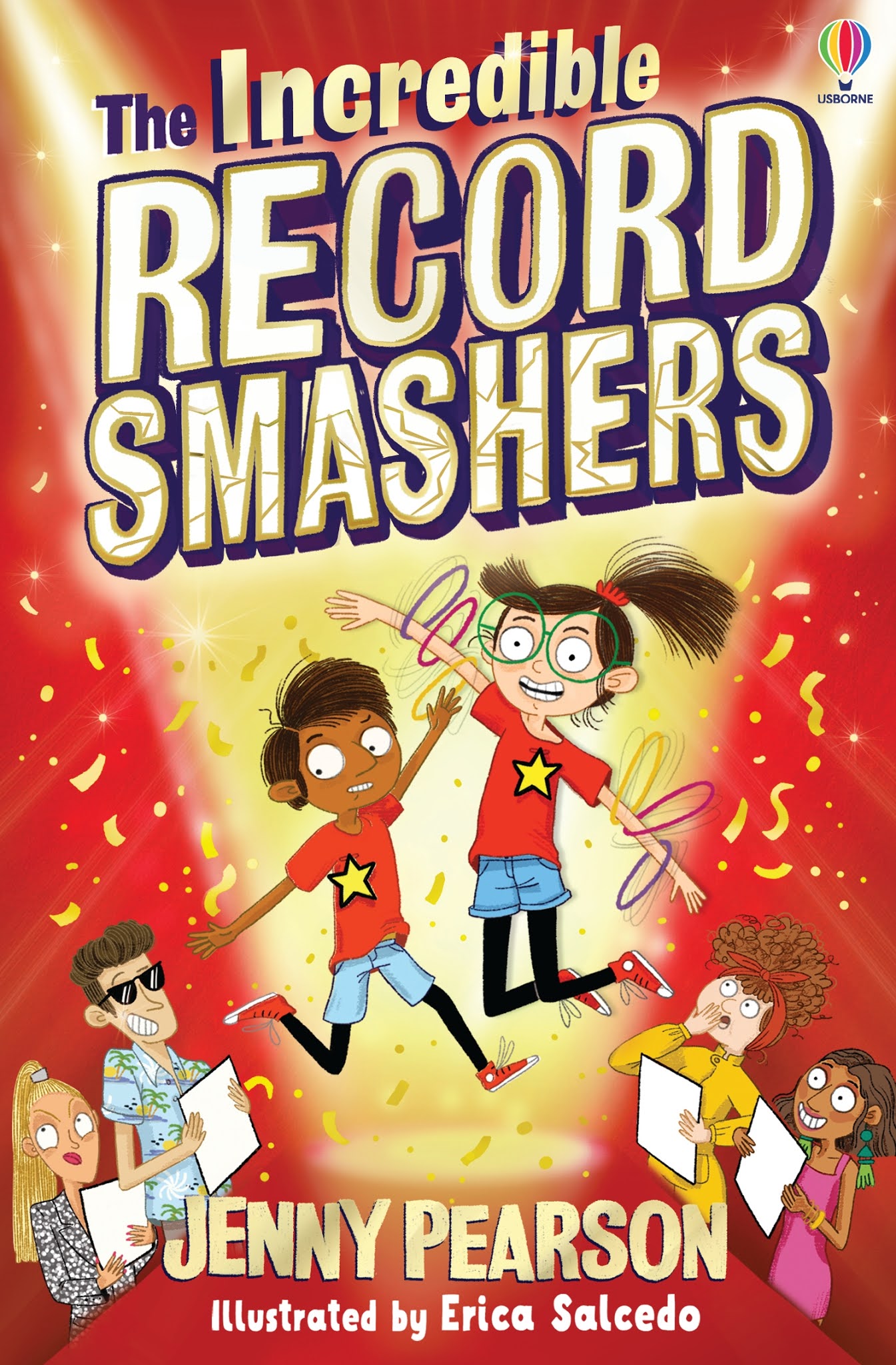
 The Incredible Record Smashers by Jenny Pearson, illustrated by Erica Salcedo  (Usborne)

Once, in an interview with Shirley Hughes, I read about where she gets the ideas for her books. Having read about her observations of children from the life and then really seeing it in her work, there has been no un-seeing it since: the boldness of children, their reticence, their great joys and their deep sorrows are all there in Hughes' portraits, in the wave of an arm, the inclination of a neck, the pointing of a finger. When a Shirley Hughes picture book is opened, we immediately see not only children, but the child's world, too, through the child's own eyes. And there is no affectation, no sugaring the pill: childhood is an exhilarating time but a confusing and frustrating one too. We know exactly the excited anticipation of Christmas in one of her books but feel the same pain of losing a beloved stuffed toy in another.

Jenny Pearson's writing also has this quality. While her books deal with grief, depression and the troubles of youthful friendships, she provides hope for all her readers by setting out the strengths and resilience of children and the solace that only true friends and family provide. Reading her latest book, The Incredible Record Smashers - which tells the tale of Lucy, her mum, her best friend Sandesh and her eccentric Aunt Sheila - I was reminded again, 'this author knows kids really well!'. This time, though, Shirley Hughes kept popping into my head, too. There are moments in the book where, like Hughes, Pearson captures a fleeting glimpse of the very personal and interior world of the child. Hughes has an eye for this - you can see the emotion in the stance of her children - and it is her genius. With Pearson, its in the instantaneous shift from laughter to tears, the joys and frustrations of childhood, the wildly crazy view of the big, wide world around that touches on the very same artistry.

Pearson sketches out the frangible lines of children's relationships with a canny eye, too: the ways in which the bonds between children - uniquely strong and easily broken or mended in the blink of an eye - are brilliantly realized. In Freddie Yates, it is the weird scrap on the boat between the three boys; in Record Smashers, there's a scene which is at once bursting with anger, hilariously comic, and completely deadpan, where Lucy throws a pre-teen tantrum, only for it to be somehow quashed then incensed further with a bowl of washing-up water. Although Pearson clearly loves her characters, and has the deepest of respect for children, she is not afraid to point out their shortcomings - what's particularly lovely, though, is that this is always done with the kindest and gentlest of smiles.

Let's not forget the way in which she paints her adult characters! Auntie Sheila is the eccentric, full-of-gumption, full-of-love grown up that every child needs in their life. She will inspire the young reader to laugh but also to think, especially about the ways in which love is shared and given. Other 'grown-ups', conversely...well, let's just say that in today's media-wow culture, we need books like Jenny's to prove that real life takes a lot more than celebrity or a TV show can ever provide. 

As with Freddie Yates, the plot is over-the-top, riotous, quite literally 'incredible'. But deep down, is it really? Admittedly, it's unlikely that two children would manage to find their way to a recording studio to present their latest crazy idea involving catching kumquats, simply to meet up with a guy who might just give Lucy's mum the seed of happiness that will grow to crush her depression - unlikely, yes, but to a child the logic of the plan is  both immaculate and inspiringly optimistic: "Why shouldn't it work? Why couldn't it happen?" Again, it's Pearson's sensitivity to the tender inner lives of children and their overwhelming hope that nurtures her storyline here. Children will appreciate that, quite naturally, and be comforted as well as entertained.

While with every passing day all of our lives change and frantically adapt to suit the pressures of modern life, it's reassuring to see with Pearson - as it is with Shirley Hughes - that young people have their 'champions of childhood': brilliant storytellers who see perfectly clearly what it means (and has in fact always meant) to be a child in a confusing world and who are always ready to share their kindness with those attentive ears and eyes who read them; and listen; and see.

The Incredible Record Smashers by Jenny Pearson is published by Usborne on 4th March 2021.

The Guardian interview with Shirley Hughes is here: https://www.theguardian.com/childrens-books-site/2015/jul/06/shirley-hughes-interview-book-trust-lifetime-achievement 

With thanks to Fritha Lindqvist for her help in the preparation of the pictures for this blog. 


Thursday, December 17, 2020

The Gumption Gang

Freddie's Impossible Dream by Nigel Lungenmuss Ward; illustrated by Robbie Lungenmuss-Ward

The Garden Gang by Jayne Fisher (Ladybird Books)  


Growing up as a reader started for me (as it did for many of a certain age) with the  Ladybird Books. Their hardback uniformity was a comfort and as I lined them up on the shelf at the tender age of five or six, they took on the importance of my own personal, miniature library. My mum was a Reception teacher and so, the 'First Book of Words' and even the packs of flashcards (now dubbed 'Vintage', I see, on eBay) were my very first forays into reading books for myself. 


Later, came something I remember being almost incredible: 'The Garden Gang' series by Jayne Fisher. These little Ladybird books each contained two stories and told the tales of Betty Beetroot, Wee Willy Watermelon, Penelope Strawberry and sundy other fruit-and-veg characters. I loved their felt-tipped brilliance and quirkiness but what was more extraordinary to me was that they had been written by a nine-year-old girl. Jayne became both a source of inspiration and of mild envy to me! 


I've never forgotten what seeing another child's work published in book form meant to me. It seemed dramatically exciting and urgent but also, even though I wrote all sorts of poems and comics and stories in my early writing years, it never seemed like something I could achieve. That's not a feeling I want to pass on to the children I know and teach - it's not OK if they think that ambitious success is beyond their reach. 


Well, in a new book from the Lungenmuss-Ward duo there is hope for everyone! 


In Freddie's Impossible Dream, the main character - a grown-up - struggles to be taken seriously as a singer. But he perseveres and manages ultimately to fulfil his impossible dream. It's great for children to see adults face difficulties, problems and even ridicule; for them to see that it's not just plain sailing when you grow up; that adulthood doesn't bring everything you ever wanted. In fact, achieving your dream takes time, commitment and sometimes even a bit of luck. 


The author's son Robbie (now nine-years old!) has illustrated the book throughout and this is where real inspiration can be found for young people. I love the interplay between word and picture: the written word leaves plenty of room for the pictures to reveal the true joy of the story with Robbie's humour and candid sensitivity to the fore. Robbie's view of the story is always uplifting, even in Freddie's saddest times; there's always some good cheer to be found. It's in these illustrations - that felt-tippy, bright cheerfulness of Jay
ne Fisher blended with a modern comic-strip wit and sensibility redolent of Jeff Kinney and Dav Pilkey (two of Robbie's heroes) - that we see a lightning strike of purest optimism. 


Nigel says in an afterword that he wrote the story to encourage his son to follow his dreams and never give up (Robbie wants to be an illustrator and animator).  I'm absolutely sure that this team - this newly founded 'Gumption Gang'! - and their strong bond will inspire a whole new generation of children (and adults too) to see that their voices matter...and never to give up in making those dreams a reality.

***

When you've read a copy, whether it's with an individual child, to a whole class, or even whole school (because this would be great to use in an assembly), you might like to start some book chat to connect the book to you and the children. Here's some starting points for you! 


Wondering about the book

  • What makes Freddie want to give up throughout the story? 
  • What makes him want to go on with his singing? 
  • Find (or imagine) all the different feelings that Freddie experiences throughout the story. Sort them into positive and negative groups. What does doing this activity tell you about Freddie's journey to achieving his dreams? 
  • Talk about what Freddie's friends and family say to him throughout the story. 
  • If you could ask Freddie a question, what would you want to know? 

Connecting the book to the reader

  • What do you do that makes you happy? 
  • What hobbies of yours would you like to show to the world?
  • Who are your biggest fans?   
  • Which of the pictures made you feel 'You could do it' if you wanted to achieve your dreams? What about any of Freddie's words or thoughts? Which of them encourage you? 
  • What makes you want to give up sometimes?
  • How did the book make you feel differently about things in your life? 

Thinking about the writer and the illustrator

  • Is it important or relevant to you that the author is a grown-up and the illustrator a child? 
  • Do you think you can tell that the author and illustrator are father and son? 
  • What are your thoughts about what Nigel says in the Afterword? Do you feel he has achieved his second ambition for the book? 

Monday, December 7, 2020

"Definitely Christmas"


Susan Cooper/Carson Ellis - The Shortest Day (Walker, 2019)
Sally Nicholls, illus. Rachel Dean - A Christmas In Time (Nosy Crow, 2020) 
ed. Tanya Kirk - Spirits of the Season / Chill Tidings (British Library, 2019/2020)
Kevin Geddes - It's All in the Booklet: Festive Fun with Fanny Cradock (Fantom Publishing, 2019)
 
Christmas books are legion. In the dark evenings of December, I do love to browse through a few seasonal reads, but I'm fussy and not one to go back time and time again to The Snowman or A Christmas Carol, genius though they both are. Rather, I like a bit of spice to my festive reading and some zesty acidity too - the cloying, sugariness of 'Olde-Worlde Nostalgia' just doesn't cut it for me. So what follows are some recent favourites of mine, which I hope might provide inspiration for stocking fillers or just some personal entertainment for you. 
Where better to begin on these darkling days than with the light that is so beautifully portrayed in Carson Ellis' illustrations for the equally luminescent words of Susan Cooper's The Shortest Day? Throughout, the spreads track the 'Stations of the Sun' both from day to night and from then on into the new day, and from late summer to mid-winter, the golden haze of the year 'dying' and the ice-cold brilliance of winter light. The old traditions of this time of the year are portrayed as something that is in our blood - these are the ways of our ancestors - and both words and pictures make these threads between the past and the present strongly felt: "Through all the frosty ages, you can hear them/Echoing, behind us - listen!"
 
It is these very echoes that answer in Sally Nicholls' latest installment in her time-travel series for younger readers, A Christmas In Time. When Alex and Ruby look through a magic mirror in Aunt Joanna's house, they meet a distant Victorian relative. Their charge is to ensure their cousin, Edith, is not sent away to the charity school that they know all too well from their own time by its terrible renown. Witty dialogue, and sharp characterisation (especially of the very lovable Alex and Ruby) sets this novel apart, and the twisty paradoxes time-travel are deftly drawn with a light touch. Ruby, at the end of the story, re-considers the 'tacky and plasticky' tinsel of modern times with distaste, and reflects on her time-travelling adventure in Victorian times: "[...] that was definitely Christmas'. The bracing visions of Christmases Past in the Cooper/Ellis and the Nicholls certainly provide a different slant (and for some, like me, a much needed one!) on the traditionally cosy festive tale.
 
The British Library continue to amaze with their prolific series, 'Tales of the Weird'. This year, they have republished (thank goodness!) a generous collection of Vernon Lee's supernatural yarns, a fine quartet of the best of Algernon Blackwood, not to mention the irresistible  'Killer Tales of the Botanical Gothic'. But as it's Christmas, I must highlight last year's offering, Spirits of the Season, and its 2020 follow-up, Chill Tidings. Each contains a superb selection of Victorian, Edwardian and mid-twentieth century spook stories, perfect for reading aloud by a crackling fire, or indulgently to yourself while the rest of the family gorge elsewhere on festive editions of 'Strictly' and 'Bake off'). Of the two, Spirits of the Season probably has the edge for me - containing as it does my favourite Christmas ghost story of all: Lucky's Grove by H.R. Wakefield, which frankly defies all belief in its chaotic mixing of Victoriana with Norse mythology - but ghost stories are a fine tradition for this time of year, so I warmly recommend both titles to send a pleasing terror your way this Yuletide!

Finally turning to the (necessary) indulgences of Christmas, and specifically to the Christmases Just-Past of the nineteen-sixties and -seventies, many will consider the redoubtable Fanny Cradock a stalwart of the season. (And if you don't, then I urge you to get straight on to iPlayer to watch the five short programmes she made about preparing your 'Christmas buffet'.) Kevin Geddes, he of @KeepCalmFannyOn, has done all of us a huge favour by re-inventing Fanny's now rare-as-hen's-teeth booklet accompanying the series in It's All in the Booklet. Now we can all gawp in astonishment at the green (yes, green) duchess potatoes, sigh with relief that - unlike 'pa' - we needn't sweat any more over the carving of the bird, and raise a doubtful eyebrow at the so-called 'baveuse' texture of Fanny's mincemeat omelette. Gedde's wonderful (and often hilarious) little volume ('it's actually more of a book') has the look of a 70s original with its lurid colour photography, and certainly promises to be an annual re-read for me. But, as Fanny would say, just don't tell those 'nasty neighbours' that you've finally got a copy. 
Happy Christmas reading!


Sunday, September 27, 2020

A Life in Pictures and Words

Fearless: The Story of Daphne Caruana Galizia by Gattaldo (Otter-Barry, 2020)


When a picture book is published these days I'm always delighted, but it's only a very few that really enter my heart. Fearless: The Story of Daphne Caruana Galizia is one of these: it coruscates in the way it tells this true story. At once there is a deep, strongly-felt passion for the woman that shines out brightly from the forest of other stories about the individual's lone voice, their persistence, their self-belief against adversity; there is also - not overtly, but still there below the surface - the roaring anger about how something so good and so beautiful could be taken from us.

Daphne was a journalist. She fought against injustice and lies. Her real-life story here told in pictures and words focuses on what we can all learn from her example: how our childhood dreams can be fulfilled, the intense place reading can carve out in our imaginations and hearts, the need to think and to ask questions. As Daphne grows up, still her example shines through to us: work hard, love each other, keep fighting the good fight. 

Pictures throughout the book depict a hazy balance between the real world and Daphne's extraordinary, vibrant imagination. Some pages show exactly what was happening in her life - playing with her children while her smiling husband looks on, for instance.  But others turn more surreal: Daphne standing waist-deep in a sea of fish, her pages and pages of written words typed out onto a swirling, almost endless stream of paper, and then that very paper metamorphosing into the snaking necks of a political hydra on the next page. We feel close to Daphne this way, maybe not consciously, but we are seeing the world as she did, stepping from the imaginative, thoughtful world of her creation, into reality, and back again. We're learning what it was like to think and see as Daphne did.

The picturebook story ends with the words, 'Daphne's writing travelled the world and inspired more and more people to speak out. Daphne had persuaded others to continue her work...and make our world a better place' and we can leave it there - the picturebook has done its work to inspire and engage and - most importantly! - to make the young reader think. But then we turn the final page and in an almost painfully brilliant flash we step out of the picturebook and into the reality of our heroine's story. 

Words tell us that Daphne was murdered, her story was cut short. 

But pictures tell us something else too, something that is Daphne's real legacy. We see Daphne smiling out at us from sharply coloured photographs, the soft pastel images of the rest of the book thrown into stark relief. Here is Daphne at the zoo with her three children, her mother, her sisters; calling out to us here - on the same page as the words that reveal the horrible truth - is family, connections, love. 

There is also a letter from the author who, having shaped words and crafted pictures so carefully and thoughtfully to get across these deep truths about his beloved friend, has the final word. For him, Daphne was a gift, listening and talking to her was a gift, being part of and writing her story was a gift. Now he shows us that, for us, this book is the same kind of thing. 

Become friends with the book, listen to the truth of its messages, hold this story in your hands and heart.

Daphne would be so proud.  


Fearless: The Story of Daphne Caruana Galizia is published by Otter-Barry on October 8th 2020

With thanks to Gattaldo for his support in the preparation of this blog and for supplying the pictures. lllustrations by Gattaldo. Author photo by Antonella Muscat.

Tuesday, September 1, 2020

*Not* a Bed of Roses

"Just One of Those Days" by Jill Murphy

(Macmillan, 2020) 

Life is not always a bed of roses. 

In fact it's more like the untidy, strewn-with-crayons, home-to-half-drunk-cups-of-coffee bed that presents itself on the cover of Jill Murphy's truthful and honest picture book, Just One of Those Days.

You may already know the family who are seen waking up in that bed. In fact, the story that began in Peace at Last all those years ago here continues straight away with the ominous words: 'It had been a long night...' as dad stretches wearily to turn off the alarm while mum can barely open her eyes. The sky outside is grey, the trees bare, the light gloomy. 

Mum and Dad sleepily get themselves ready for work. Baby Bear is allowed a few moments more of his dream of dinosaurs but all too soon even he has to face the reality of day. 

And what a day it turns out to be: miserable weather, upsets in the nursery, coffee upsets in the office...even Mum's blueberry muffin treat can't be properly enjoyed. The whole family experience a lot of problems that we're all familiar with...and would equally prefer not to have to face!

But there is comfort to be found in family. After all the troubles that Life has thrown the Bear family that day there's a pizza treat and comfy pyjamas and flaking out on the sofa: Life's simple pleasures that are often forgotten. The wonder of this picture book is its invitation to slow down and think about the things that our own lives offer that are sometimes taken for granted. As much of the book is about the little joys as it is about the down-sides: this symmetry is so important to recognise and the structure of the book reflects it beautifully. 

Murphy's illustrations engage us in making time to consider the everyday in new light, rather as Janet Ahlberg's do: there is the same warmth and realism. In both artists' work the fairy-tale fantasy acts as a foil to what is ostensibly very real and very familiar - ultimately what fairy-tale is all about, in fact - while the tiny domestic details they include make for instant appeal. Look at how Baby Bear's salad differs from mum and dad's at the end of Murphy's book, for example: What does that tell us? How do we relate? 

It's been forty years since Peace at Last, but here the bears wake up to reveal their story as fresh, timeless and as universal as ever - Life may not be perfect; but what we make of it can be just that.